


How to Stop a Meltdown Autistic Related
What is an autistic meltdown?

Individuals with autism are more likely to have increased sensory stimulation which can trigger a meltdown autistic related.
Because of this, sensory overload can cause an autistic meltdown.
A meltdown autistic related is when an individual with autism is unable to control their actions and behavior.
When an autism meltdown is occurring, you’ll notice that the person does not respond to help in the way that they typically would.
Touching a person during a meltdown typically makes the meltdown worse and prolongs the meltdown autistic related.
What does an autistic meltdown look like?

A meltdown will look different for each person with autism.
This is because autism affects each individual differently along with the sensory issues a person might have.
This usually includes crying, stimming such as rocking, kicking, and sometimes physical violence. Running away, hiding, and wanting to be alone or in the dark is also common.
Individuals with autism aren’t able to communicate typically during a meltdown autistic related issue.
There may be screaming and grunting because functional words aren’t able to be used.
There are many times that meltdowns include physical destruction of the area that the person is in.
This could include ripping paper, kicking things on the floor, and throwing items around the room and at people nearby.
The most concerning autism meltdowns are when situations become unsafe for the person with autism in the meltdown and those around them.
What triggers autism meltdowns?

Sensory Overload
The most common trigger for an autism meltdown is sensory overload.
This happens when situations are outside of a person’s control.
In a school setting this typically includes a loud gymnasium, convocation, or a classroom party.
The Autism Gut
Believe it or not, a meltdown autistic related issue can also occur from the autism gut.
People with autism are known to have major digestive issues and often don’t have bowel movements but once a week.
I’ve seen many, many times that a student has a massive bowel movement at home or school and the next day has an autism meltdown.
From my reading and research, this occurs because of the level of toxicity that was released into the child’s body while the bowels were trying to empty.
From observing these students, it appears as though they are contracting the flu.
So what can be done?
Try to introduce as many vegetables and fruits as possible. Drink as much as possible.
If your child can swallow pills, add a daily magnesium pill or a magnesium drink to their diet.
Give them epsom salt baths. Please remember that I am not a doctor. This is not medical advice. Please consult a doctor with all health issues.
A Change in the Schedule
Another common trigger for autism meltdowns is a change in the schedule.
There are so many examples of what this could be and most of them are unavoidable.
A change such as their teacher being absent or the cafeteria not serving what they said they would on the menu could cause a meltdown autistic related.
Unschedule and undesirable events such as a fire drill are most likely to trigger a meltdown autistic related tantrum.
How long does an Autism meltdown last?

Autism meltdowns can last anywhere from five minutes to hours.
The people and the environment can decrease or increase the time of an autism meltdown.
Different meltdowns last different amount of times due to the severity and the people helping or hurting the situation.
Let’s go back to the cafeteria example.
Let’s say that I have a student who loves chicken patties.
When we get up to the cafeteria, there are no chicken patties.
Crying begins and my student falls to the floor kicking due to lack of chicken patties aka an autism meltdown.
So how could this meltdown end quickly?
Yep, you guessed it: a cafeteria lady comes out with another sheet full of chicken patties.
Then, I visually show my student the chicken patty and they realize that they still get their meal.
The meltdown is over.
Next, lets look at how this meltdown ends more slowly.
I very softly but directly tell my student that I will help him when they stand back up.
Then I wait.
I make no more verbal comments.
I do not touch my student.
I do nothing to promote or trigger the behavior.
A tantrum is not a teachable moment.
Typically when I treat a situation like this the tantrum is over in five minutes. Or at least highly manageable.
Now my student and I might leave the cafeteria with no food choices.
This is unfortunate but a physically safe choice.
I always have a stash of food for the kids in my classroom that I know they will eat so my student will not go hungry.
How to recover from an Autism meltdown?

The main way I use to recover from a meltdown autistic related issue is time.
Once I had a sixth grader who became extremely upset in the general education classroom.
He was loud, crying, and unable to be reasoned with.
A tantrum began that prevented the academic education of the other students and the student with autism.
He was willing to leave the classroom to go to the safety of my special education room.
As soon as we entered the empty room, he fell on the floor kicking and screaming.
I told him that I would be at my desk and to please let me know when he was ready.
Please note that I did not sit with him, ask him what was wrong, or demand he stop.
I just let him be.
About 15 minutes later he set up on the floor and sniffs his nose.
Then he said, “Mrs. Koehler, I’m ready.”
I asked him to sit in a desk and I sat down next to him.
We talked about the problem that triggered the issue and what we could do to fix it, therefore, coming up with a plan.
Then I talked to him about his crying tantrum.
I asked him how he felt about me walking away and letting him know that it was up to him how long he needed to cry.
He said he really appreciated it and I did exactly what his mom does at home.
I’m happy to report that he didn’t have another single crying tantrum like that that school year.
He was able to regulate his behavior and accept my help from there on out.
Meltdown Autistic Support
But not all of my students are able to debrief that easily. I often use a communication board to help them express their wants and needs.
Monitoring controls help as well.
I had one student who would not speak to me at all when he was extremely upset.
However, when I pulled out my monitoring controls I found out that he was having suicidal thoughts and literally did not want to voice those.
He was willing to point and touch the categories that he was feeling.
Later he was even willing to type out his thoughts back and forth with me but he wasn’t able to verbalize them out loud.
Social stories are another extremely helpful tool to use when recovering from a meltdown autistic related.
These are detailed stories that tell a person what to do.
They give educators and caregivers a great structure and guideline for supporting challenging behavior.
How to prevent a meltdown autism-related issue

While you might think that no one wants to go through an autism meltdown, I unfortunately would have to disagree.
I’ve watched students appear to crave the energy build up that the meltdown provides followed by the fantastic release of emotions.
Many of my students with autism are not physically active.
It’s my assumption that a meltdown is a physical release that they haven’t yet figured out how to get any other way.
Because of this, I highly recommend that some physical exercise is put in place daily.
I had one student who almost never had a meltdown and I attribute this to his favorite pasttie.
His go activity was walking. He would walk for hours if you let him.
His mom and I would have to make sure that we monitored the amount of time that he walked so he wouldn’t physically exhausted himself.
My top recommendations for physical exercise include
- Walking
- Swimming
- Jumping on a trampoline
- Swinging
- Balancing and wiggling
- Therapy ball rolling
- Body sock walking and rolling
Visuals to Prevent Autism Tantrums

While this is helpful, most people with autism will need additional tools. I love using cue cards for this.
Cue cards are such a simple tool but oh so valuable.
I love keeping mine on a metal ring that I can attach to a pants loop or lanyard to make it easy for me to flip to the right card at the right time.
Using visuals is my number one approach to help my students with autism remain comfortable.
First, Then boards show a student what I’m expecting of them and then whatever reward activity follows the work.
This simple tool works beautifully at preventing meltdowns.
Next, an I’m working for a board also helps those with autism see that after they’ve completed anywhere from one to five tasks they get every reward or a break.
These are very versatile and wonderful to use in the general education classroom, special education classroom, and at home.
What to do when an autism meltdown is happening

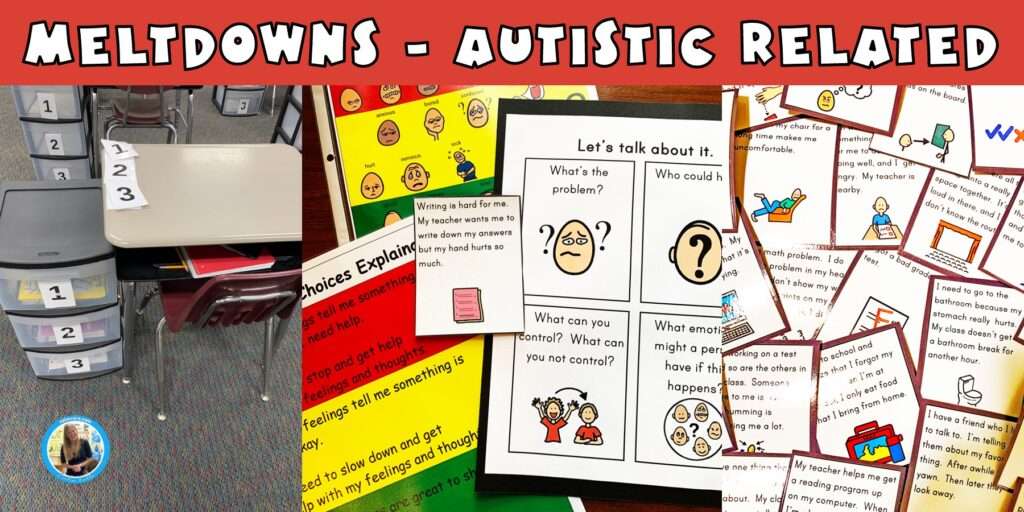
When an autism meltdown is happening use the tools and procedures that you’ve taught the student.
If you’re using a communication board readily and the student understands how to use it, give them this tool.
Next, if you’ve been using the volcano visual with a student pull it out and ask them what level they are at.
Then remind him that you’ve practiced this and have them show you what they’re supposed to do when they’re at that level of the volcano.
Perhaps you’ve been using behavior interventions and talking about the different responses that can be done for each the situation.
Use this chart to guide your student through making a safe and healthy choice.
This might involve using a feelings chart and then drawing about their feelings.
Maybe your student has been practicing using break room cards.
Pull out the break room card and ask them to use it.
Now’s the time to put all of the behavior teaching you’ve been using and working so hard at to the test.
When a meltdown autistic related is over
When a meltdown autistic related issue is over, first breathe.
Make sure that everyone feels safe and is able to get back to their daily schedule.
Then within the next 24 hours debrief with your student.
Without attempting to trigger a negative behavior, discuss what went right.
Practice what can be done better next time from all involved.
As the adult analyze what extra support you can put into place.
Maybe your student needs more coping strategies for challenging behaviors.
Or you might feel that your classroom could be more focused towards the needs of those with autism, you seek out more autism visuals for your classroom.
You might find that your student needs more help with understanding procedures in organization.
This could involve check-in and check-out pages throughout the day.
And, lastly, you need to determine if your student either needs a crisis plan or if their current crisis plan needs updated.
This helps you identify what works best for your student and who can help. These are often included in IEPs and cumulative folders for students.
And remember, a meltdown autistic related is not your fault but an opportunity for you to help those with autism.


