How to Do Morning Meeting
Morning Meeting is an exceptional activity that should be done daily with every self-contained classroom for students with special needs. Use the SAME sheets each day and save so much planning time! My students with mild to severe disabilities work on this skill daily in small groups with an adult facilitator. This amazing activity is great for any student who needs continual practice to communicate their safety information. It can also be used for preschool or early elementary aged students who are learning their personal information and becoming emergent readers.

Getting Started
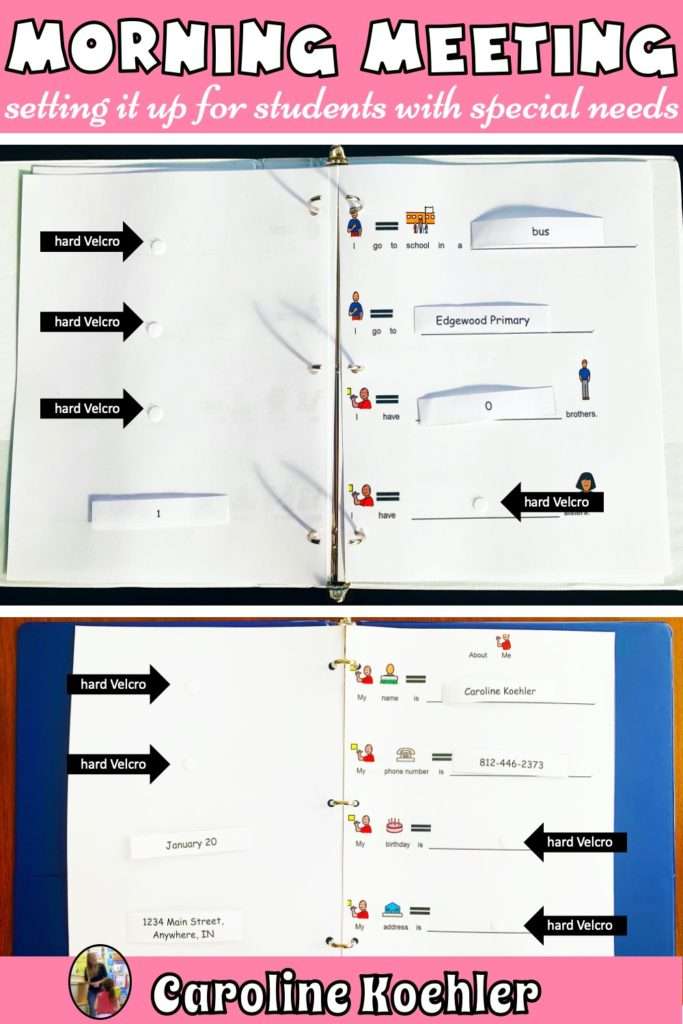
First, I decide what information is most important for my students to learn. I typically focus on name, address, phone number, birthday, age, parents’ names, and gender. Then I print out the desired informational pages for your students (see what Caroline uses below). Laminate, cut out, and then hole-punch the pages. Next, I pop the page set into a 3-ringed binder. On the lines within the question pages, I place a piece of hard Velcro centered on the line. These pages go on the right-hand side of the student’s binder. On the opposite left-hand page of the first student info sheet, I add a laminated white piece of paper that holds corresponding hard Velcro dots mirroring the right-hand side page. Velcro dots are placed on the back side of each page afterward which gives a spot for the students’ info to remain until I prompt them to move it.
For Students with Intellectual Disabilities
When I am working with students with severe/moderate cognitive disabilities or young students who are just learning to read, I type out the students’ corresponding information into a grid. After typing out all of the information for each student that I am working with, I print the info and laminate. Next, I cut out each information box and apply a soft piece of Velcro (soft travels meaning any moving part of my classroom’s Velcro collection has soft Velcro) to the back of each movable text box.

Morning Meeting’s Lesson Plan
I use this in my classroom as a daily 15-minute activity. I’ve utilized it a few different ways for a school day: a first of the morning activity for all, a 1-1 academic learning time with me, and a small group activity with no more than 5 students in a group. (See the picture below with a snapshot of a daily schedule in my classroom.) Usually I have two small groups that rotate through in a back-to-back time slot. Here’s how I run it no matter which time of day I select! The students’ information begins on the left-hand side of the page. Next they will place, either independently or with hand-over-hand assistance, the correct information one piece at a time after I’ve verbally asked each question. Doing this completes the sentences on the right-hand side of the page.
If the students are verbal, they are expected to read or echo the sentence back to me. Student who have a voice output device have the machine set up to ensure that they can actively participate. Students are encouraged to verbalize, but those students who are not yet able to do so are still asked questions. These kiddos are still expected to move their written information from left to right into the appropriate spot daily with or without adult assistance as needed.

Spice It Up and Make It Meaningful
Once the students find comfort with the routine of this activity, I spice it up a bit. Instead of asking the questions in order from top to bottom on the pages, I mix them up. This ensures that the students don’t go into “robot-mode.” I even might ask a question that’s not on the page to see if the students can redirect me.
Likewise, I also rotate out the main person (typically me) so that the students can get used to being asked these questions by lots of different people. So who are great people to volunteer into this role? I recruit my principal or assistant principal, any assistants in the classroom, the school resource officer, an inclusion teacher, and any parent volunteers. The importance of doing this can’t be overstated. I need my students to be able to identify their personal information to any adult if they are lost or need help in the community.
Lastly, I don’t always hold Morning Meeting in the same spot. Sometimes it’s at the large work table, on the carpet, or in the hallway. Other times, I head my group to the gym, to the front office, or outside on the playground. This helps the students translate this skill into multiple settings.

Ready, RESET, Go!
I reset the Morning Meeting binder at the end of each school day so that the student can practice this each and every day. I simply move the student specific information back to the left-hand page, and I’m ready to go for the next day!
Extending For Higher-Level Students
Similarly to a typical morning meeting, follow the directions above for the higher-level answers. Any student that is able can receive regular paper copies of this book and write directly on the line. I still use laminated pages for this and give the student a wipe-off marker so I can clean it quickly at the end of the day. My set of higher level questions have more than one answer such as, “What did you do last night?” This is a great way to teach early conversational skills.

Get your ready-to-print
Morning Meeting Work Pages: Expressing Personal Information