


IEP Evaluation Process Streamlined
As special educators, we all know how much work goes into every IEP evaluation when we want to truly meet our students’ needs.
Let’s check out beneficial resources to gather evaluation data, write meaningful reports, and build an IEP that works.
Think of this as one teacher helping another: I’ll share why each tool is helpful, how I use it in real settings, and tips to maximize its value.
If you’re preparing for or in the midst of an IEP evaluation, these resources can make your process cleaner, more defensible, and far more student-centered.

Collecting Teacher, Parent, and Student Voices with Input Forms
One of the first places I start during an IEP evaluation is gathering perspective from all stakeholders: the teacher, parent, and the student when appropriate.
The IEP Input Forms Teacher, Student, Parent bundle does exactly that.
This bundle includes forms for parents, students, and teachers in both PDF and editable formats.
How I use it: I send parent and teacher forms about two weeks ahead of the evaluation meeting so I have time to review responses.
I give students a simplified version to fill out or interview them using key questions in the student input form.
Benefit: It ensures you have rich qualitative data to add to your present levels, and it often reveals concerns or strengths you might not see in test scores.
It also helps build parent buy-in because they feel heard.
Tip: When you get the responses, highlight keywords or repeated themes. Use these to draft your PLAAFP statements and to guide what assessments you still need.
Example: If multiple teachers note the student “struggles to complete work on time” and parents say there is “difficulty focusing at home,” that signals you need time/on-task data or observation.
The input form makes that clear and usable.

Using Observation Data Tools during the IEP Evaluation
After collecting input, observations are often the richest source of data in an IEP evaluation.
The Student Observation Forms, Checklists, IEP Data Collection with Summary Template helps you do that efficiently.
This set offers multiple forms (checklists, frequency observations, detailed behavior observation forms) plus summary templates.
How to use it: select a few observation moments during natural instructional time (transitions, small group, independent work).
Use checklists or frequency grids to log what you see.
Then use the summary template to write a polished narrative for your IEP report.
Benefit: It gives you both quantitative (counts/frequency) and qualitative (narrative) data.
That dual evidence is powerful in meetings when discussing impact and need.
Tip: Use these observations to cross-check what teachers and parents said in the input forms.
If a behavior is noted by parents but not yet observed at school, schedule additional observations or probe in different settings.
Example: If input forms suggest difficulty with peer interaction but observations show mostly adult interaction, you might arrange peer group observations or social-skill assessments.
Grab a free best practices download here!

Crafting Clear PLAAFP Impact Statements
Your IEP evaluation really depends on a strong PLAAFP (Present Level of Academic Achievement and Functional Performance) statement.
The PLAAFP Example IEP Impact Statement Present Level of Performance Template is a gem.
This template offers examples for academic (ELA, math, writing), behavioral, functional domains. It includes prompts and structure for baseline data, strengths, and impact.
The present levels of achievement are required during evaluation whether or not the student qualifies for an IEP.
How to use: once you have your data from input forms and observations, start filling in this template.
Pull in specific numbers, behavior data, teacher/parent quotes, and then explicitly state how the disability impacts the student’s access or performance.
Benefit: When your PLAAFP is clear, your goals, accommodations, and services follow more logically—and the IEP team, including parents, understands why certain supports are proposed.
Tip: Don’t wait until the end; draft a rough PLAAFP early in the evaluation so gaps in data are obvious. Then target what more you need to collect.
Example: “Because of delays in reading decoding, the student reads most grade-level texts with 60% accuracy, which slows comprehension and causes fatigue. This impacts performance in science and reading class.”
That kind of specificity is transformational.
Analyzing Behavior: FBA Template Helps Identify Why
When behavior concerns arise as part of the IEP evaluation, you need more than anecdotes—you need data and analysis.
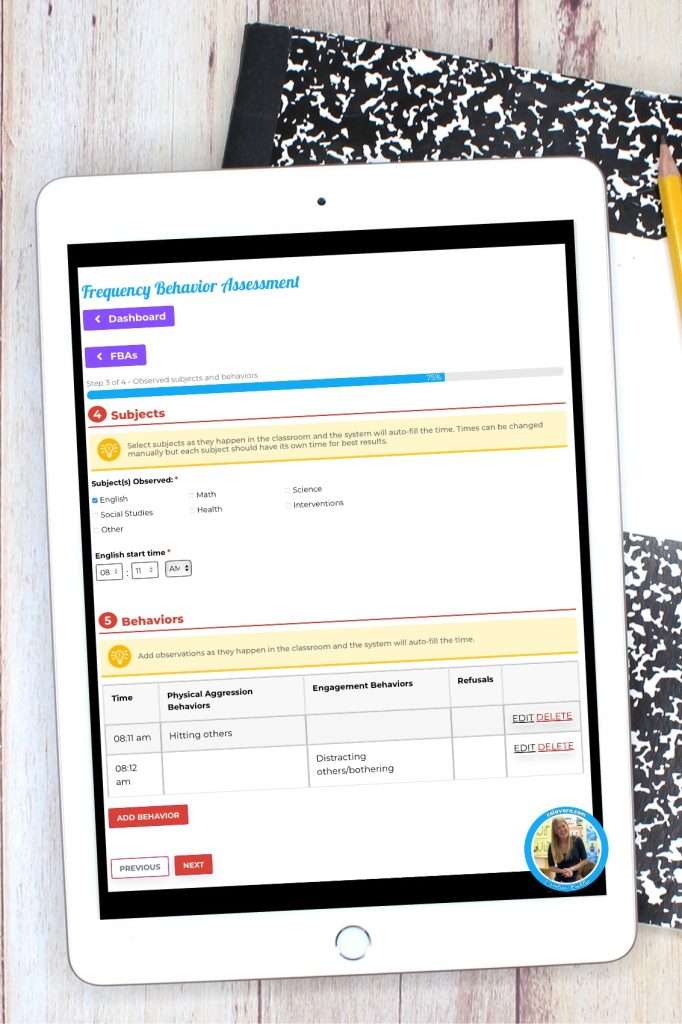
The FBA Template Functional Behavior Analysis Data Collection supports this.
This set gives you observation grids, ABC (Antecedent-Behavior-Consequence) documentation, summary sheets, surveys for teachers/parents/students, and sometimes auto-charts for summarizing.
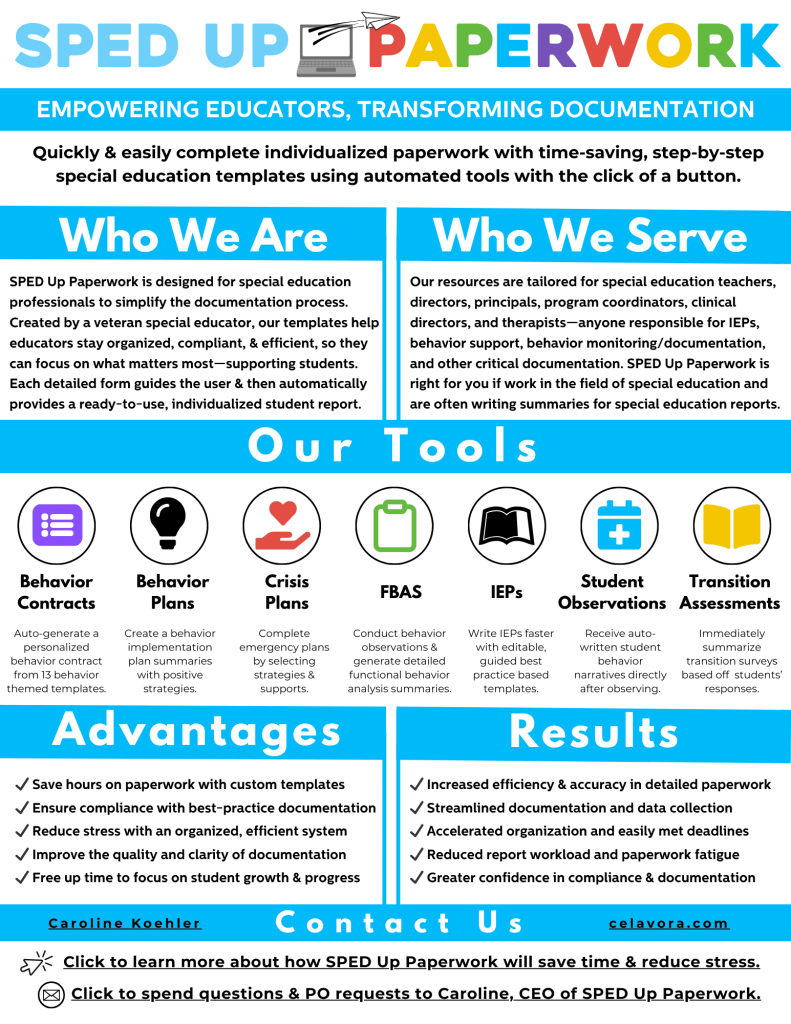
While paper and pencil are the traditions forms for completing FBAs, make sure to check out SPED Up Paperwork for digital tools that summarize your findings automatically.
How to use: Once behavior or adaptive functioning is flagged, plan a period of observation.
Use the ABC grids to note triggers (antecedents), what exactly the behavior is, what follows.
Gather stakeholder input. Use the summary sheets to detect patterns.
Benefit: You’ll better understand not only what the behaviors are, but _why_ they’re happening.
That helps you craft interventions that are likely to work—and helps defend your recommendations during a meeting.
Tip: Spread observations over different times/settings.
Behavior may vary between lunch, recess, math, etc.
Also look at communicative and environmental factors, not just student intent.
Example: If refusals spike during math with group work, and teacher input says student feels overwhelmed in peer groups, you might propose scaffolded group work or alternate formats as accommodations.
Remember that these types of proposals are needed whether or not the student qualifies for special services.
Grab the free best practices guide for FBA completion here!
Designing Behavior Support with BIP Tools
Once you’ve completed your FBA, you need a plan for what to put in place.
That’s where behavior intervention plans come in during the IEP evaluation follow-up.
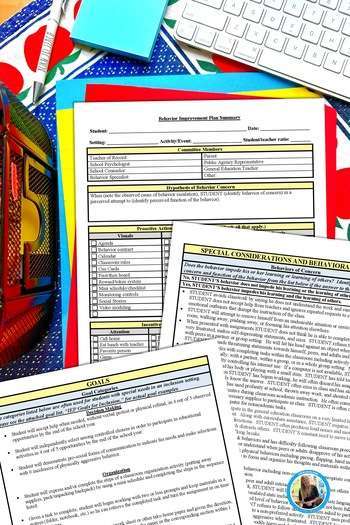
The Behavior Intervention Plans Positive Behavioral Support template set is made for that.
This resource gives you structure: replacement behaviors, reinforcement strategies, supports, the roles of staff, data collection plans within the BIP.
How to use: After completing your FBA and gathering data, draft a BIP using the template.
Share it with teachers and related service providers.
Decide who does what, when, and how you’ll measure progress.
Add in accommodations if needed.
Benefit: You get a cohesive plan, not just ideas.
Everyone on the IEP team sees how behavior will be monitored and supported.
It also strengthens your IEP evaluation report and offers clarity in implementation.
Tip: Review the BIP periodically (monthly or bi-monthly) early on.
Make sure the interventions are in place; adjust if needed.
Also bring in student/parent feedback to see what’s working outside school too.
Get best practices for positive behavior planning here!
Writing Robust IEP Goals with Goal Banks
Once you have present levels, input, observation, and behavior data, you’ll need to write goals that align with all of that in your IEP evaluation report and final IEP.
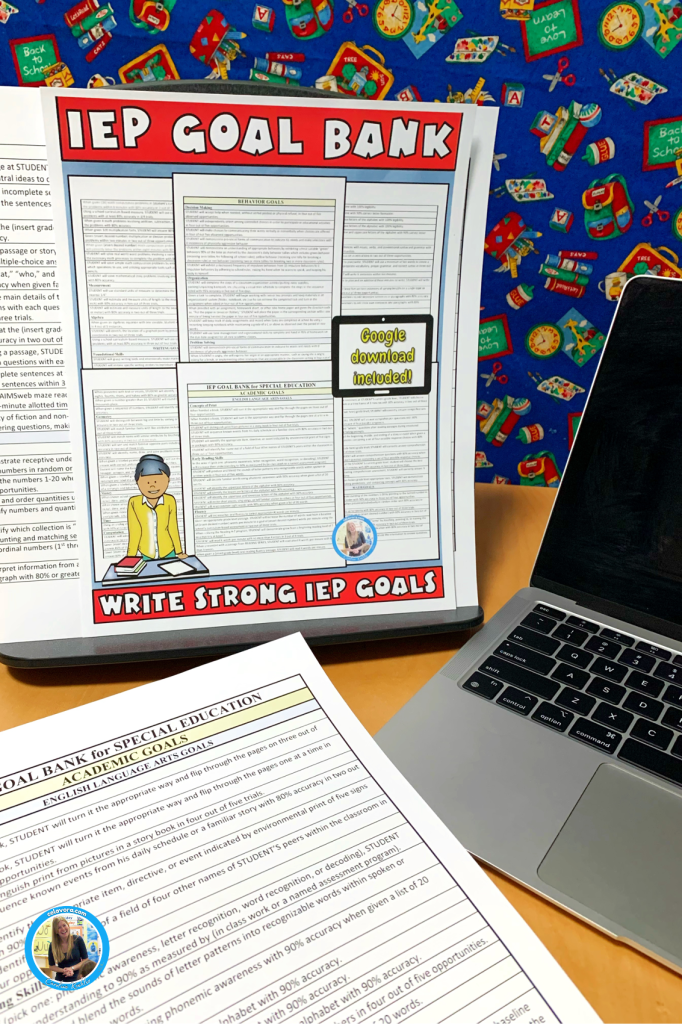
The IEP Goal Banks Special Ed Goals ELA Math Behavior Functional Life Skills is one of my go-to’s when I need strong goal language.
This goal bank gives sample goals in ELA, math, behavior, and functional life skills.
It helps spark ideas, ensure your goals are measurable, and that they align with present levels.
How to use: After drafting your PLAAFP, pick the one or two areas where you see the greatest gap.
Use the goal bank to adapt a goal to your student, making sure you specify baseline data, measurable criteria, and timelines.
Then, review the goal language with your team and parents to ensure shared understanding.
Benefit: You cut down writing time, avoid vague goals, and ensure your IEP is measurable and aligned.
A strong goal bank means you less frequently reinvent the wheel under deadline pressure.
Tip: Always cross-check that your goal is feasible with existing supports, services, and accommodations.
If a student has limited instruction time in one subject, you may need to adjust the goal accordingly.
Make sure you build in data collection from the observation tools you used earlier.

Support for Writing IEPs in Complex Settings
Sometimes the IEP evaluation and writing process is tougher—cases with inclusion + severe or moderate needs—and you want a guide to help you pull it all together.
The Special Education IEP Writing Help Guide Bundle for Inclusion Severe Moderate (if available, check your purchase) gives you a roadmap for those complex situations.
How I use guides like this: I sit with the bundle before beginning writing.
I map out a timeline of what I have and what I need (input, observation, assessment).
Then, I use the language scripts in the guide to ensure I account for best practices: access, accommodations, service delivery, co-teaching, and functional skills appropriately.
Benefit: It helps prevent “oversight” issues (forgetting a needed accommodation, misunderstanding how to adapt goals for severe/moderate levels).
It also helps you argue clearly during team meeting why something is needed because you can refer to best practices in the guide.
Tip: Use the guide to check your draft IEP against a checklist (maybe from the guide) so you can internally QA before sending to parents.
Having that external lens often catches missing pieces.
Pulling It All Together in Your IEP Evaluation
When preparing for an IEP evaluation, using these seven tools together builds a powerful system.
You start with input forms (teacher, parent, student), gather observation data, craft focused PLAAFP statements, analyze behavior with FBA, build behavior intervention plans, select goals from a goal bank, and use the writing-help guide when things are complex.
Each step feeds into the next, reducing guesswork and helping everyone on your IEP team see the logic of supports, services, and accommodations.
My challenge for you: pick one of these tools you don’t currently use, try it in your next evaluation, and notice how it changes your workload and the clarity of your IEPs.
If you’re ready to get started, download these resources now to strengthen your IEP evaluation workflow and create more meaningful, effective IEPs for your students.
baHere’s to making your next IEP evaluation smoother and more meaningful than ever.


