


6 Time Saving IEP Teacher Tools
If you are an IEP special education teacher, you’re probably on the hunt for IEP teacher tools to save you time and energy.
You know first hand that the process of writing and implementation of IEPs is time-consuming and, seemingly, never ending.
Fortunately, there are many IEP teacher 📝 tools available to help you save time while still providing quality services to your students.
I’ve rounded up my six time-saving IEP teacher tools that you can use in your 📚classroom.

IEP Teacher Scripted Templates
When I first started writing IEPs, I was going back and forth between old IEPs to copy language that the same or similar for each section.
For instance, one section of the IEP requires documentation of the student’s transportation. Most of my students either have typical transportation or special education bus transportation.
I needed one of two sentences.
🚌 Student’s transit time and transportation needs are the same as non-disabled peers; therefore, special transportation is not required.
Or
🚌 Student requires special transportation in order to maintain safety. STUDENT’S needs warrant the assistance of a bus monitor personnel in addition to the bus driver.
So, what’s an IEP 👩🏫 teacher to do?
She created her own IEP Document Help Guide. (Pats herself on the back while projecting a victory smile.)
Then, I turned this into a 💻 digital tool that allows you to quickly and easily select scripted phrases for IEP documents.
The tool includes pre-written sentences that teachers can copy and paste into new IEPs.
I also often copy the script that I need, paste it in, and tweek it just a bit to make it work for the present student.
This help guide is a resource I use with EVERY SINGLE IEP I’ve ever written.
I had one sped teacher friend who saw me using my help guide and asked for a copy.
“You bet,” I said! And sent it on to her.
Then I had another request. And then another. Followed by, yep, another.
That’s when I realized I need to spruce it up, give it 🔗 clickable links (saved me sooo much time!), and make an inclusion version and a severe/moderate version.
This tool is great for teachers who are new to writing IEPs, or for those who want to save time on the creation process.

Student Observation IEP Teacher Tool
I started doing student observations when my school psychologist added the observations to her “best practices” list.
For every student referred for a SPED eval, she requested that the special education teacher do an observation. 👀
Like most things in the special education world, there was no IEP teacher form for observations.
I edited one of my behavior monitoring tools for progress monitoring to capture on task and off task behaviors.
This 💻 tool is quick and easy, and it provides you with valuable information about each student’s classroom behavior.
Using a ready-made observation form is a great IEP teacher tool for those educators who want to save time on the observation process.
This includes those teachers who need to do a large number of student observations and get them done as quickly as possible.
After I created my record keeping form, I added in a summary template.
Almost all of my summaries were starting off the same.
This included a pretty standard set of information that was important for each student observation report.
- Student’s name
- Date of the observation
- Length of the observation
- Location of the observation
- Student-teacher ratio
- Observer’s name
After I created the summary template, I realized that I was writing the same reports over and over again with the details and notes changing out.
And I wondered, “Can this be automated???” 🤔
The answer was yes! 🎉 I worked with a programmer who created an auto-generated report as soon as I finished the form.
Let me tell you, this is a game changer.
No more writing reports. No more wasting time typing at my computer.
Interested in saving time with SPED Up Paperwork? Click here to sign up for the membership.

IEP Progress Monitoring Tool for the IEP Teacher
This tool helps you track progress to meet IEP goals and objectives.
The progress monitoring process can be daunting and hard to document.
But the monitoring of each IEP goal 📋 provides the special education teacher with valuable data about each student’s progress.
The trickiest goals to monitor, in my opinion of course, are behavior goals.
I recommend making or buying a collection of progress monitoring tools.
Then, use a goal bank (see below in this article) and base your behavior goals on the student’s needs.
Match the needs with a goal from the IEP teacher goal bank. 🏦 Next use the progress monitoring pages to track the goals.
This tool is great for teachers who want to save time on the progress monitoring process.
Progress monitoring pages are great documentation for special education IEP teachers.
This allows teachers to determine if benchmarks were met and what goals should be put in place next.

IEP Goal Bank
Before creating an IEP teacher goal bank, I have vivid exhausting memories of staring at the computer screen with the IEP online program blinking at me.
There I sat, wondering 🤔 what goal would be best for my student.
Say, I needed a reading comprehension goal.
I had gathered my data including grade level benchmarks and standardized testing.
But I just didn’t know exactly what to write.
So, I went back through my old written IEPs once again and started pulling out all of the old ones that were well written or had good back bones.
Then, I edited them and began categorizing them.
I had a group of 6 main categories with subsections in most. 📕
- ELA – concepts of print, early reading skills, fluency, comprehension
- Math – number sense, geometry, money, time, computation, measurement, algebra
- Writing – foundational skills, sentence writing, paragraph writing
- Behavior – decision making, organizational skills, problem solving, responsibility, routines, self-advocacy, social, work completion,
- Communication
- Functional Skills
Then, I created a clickable table of contents just like I did for the IEP teacher help guides. 🖱
The goal bank provides you with access to pre-written goals and objectives.
This tool is great for teachers who are new to writing IEP goals, or for those who want to save time ⏳ on the goal-writing process.
Anything that keeps me from not sitting and staring at a blank IEP makes my heart feel lighter!

Emergency Crisis Plans for the IEP Teacher of Record
Some students require additional support within the IEP for crisis situations.
This is typically related to an undesirable social behavior but could also be used for ⛑medical emergencies.
Harmful behaviors such as self harm and harm to others would warrant a crisis plan.
Medical issues could as well such as those students who are prone to seizures, those with high needs diabetes and other chronic medical issues.
Having a template that allows the teacher or administrator to document what staff should and should not do in an 🆘 emergency crisis is vital for the students’ well-being.
Within the template that I use, I describe what a crisis looks like and feels like to the student.
Then I ✓ check off potential triggers including changes or events that overwhelm the student and early warning signs to watch for.
This checklist is a compilation of items that I’ve used throughout the school years.
Next, I create a list of contact people including their contact information who can help the student during a crisis.
Afterwards, I list what assistance should be given immediately.
Lastly, I list any prescribed medication 💊 that medical personnel need to be aware of in the event that medical attention is needed.
Of course, the crisis plans that I create are formed with the help of the family and the student.
These can be vital in the health and wellness of my most high need students.
I make sure that a copy is included in the student’s permanent record so the administration and secretaries can access them quickly.

Functional Behavior Assessment
A functional behavior assessment looks at a challenging issue or time during the day and attempts to figure out what could be causing the harmful behavior.
I love the information that the IEP team receives when a functional behavior assessment is completed.
However, I take a deep sigh each time one comes up.
Why?
Well, the paperwork, of course. There’s so much of it. 🧠
I conduct FBAs similarly to how I do student observations.
When I created my student observation forms, I used my FBA grids as a starting point.
The main difference is that I’m only looking for negative behaviors in an FBA.
I’m also further analyzing the behaviors and asking questions to help me determine what prompted the behavior.
- What was the event preceding the behavior?
- Was the student seeking something or evading something?
- How did the adult in charge respond to the behavior?
These questions along with the frequency of the behaviors and times the behaviors occurred are all important pieces of the functional behavior assessment.
I recommend having a set of ready to use FBA grids at your disposal.
My most used frequency analysis sheets are engagement, physical aggression, refusals, and communication.
The Efficient Special Education Teacher
These 6 time-saving ⏰ IEP teacher tools will help you save time on creation, monitoring, and writing processes.
With these tools at your disposal, you can easily implement quality IEP services in your classroom without spending hours on the paperwork involved.

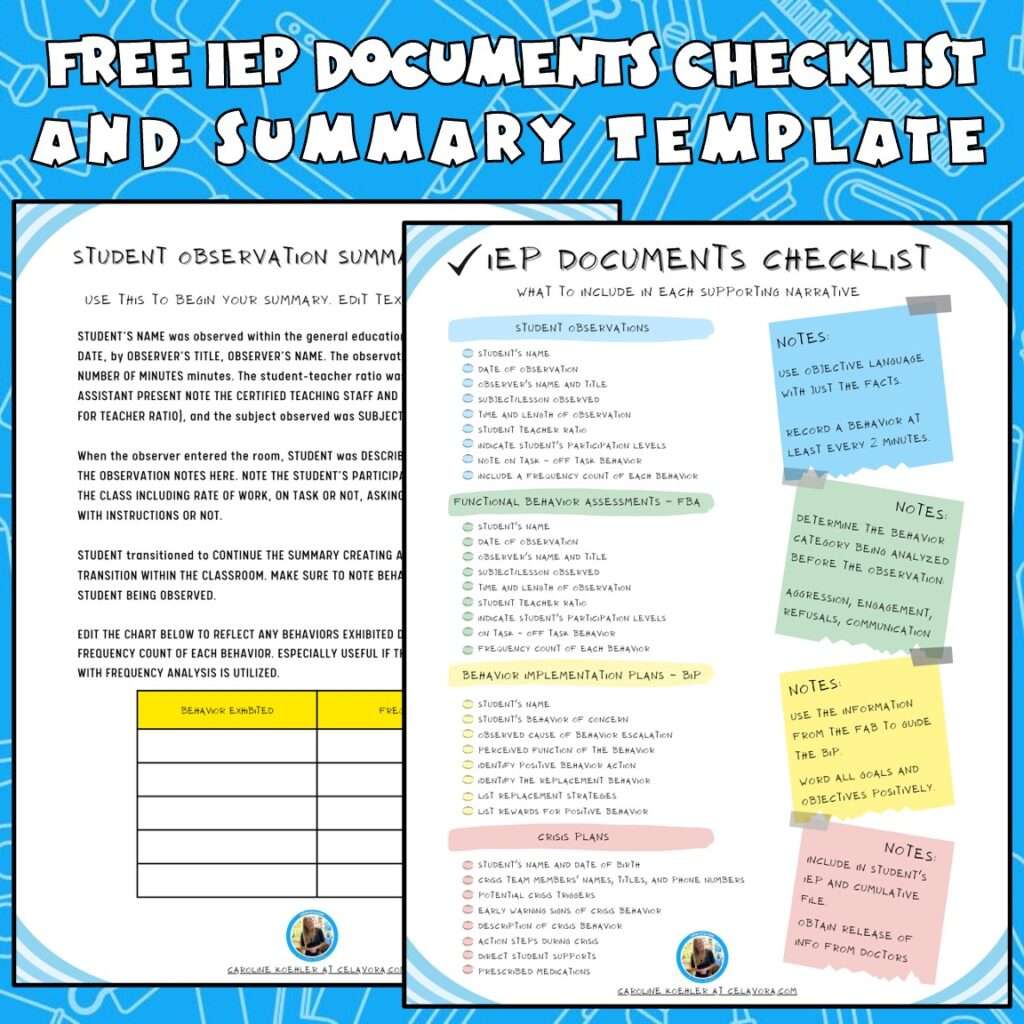
Click here to snag Caroline’s IEP Teacher Document Checklist and Summary Template FREEBIE!!!
Try out these IEP teacher tools today and see how they can help streamline your IEP process!


