Using Charts for Behavior Improvement Support
In today’s world, teachers see an overwhelming amount of complex 📊 charts for behavior data and information that can make decision-making a challenging task.
But what if there was a way to represent this data in a format that could be easily understood and beneficial for student growth?
Not only can data from behavior charts improve our understanding of data, but they can also enhance our ability to help students regulate their behavior.
Even more powerful, these charts for behavior can support behavior improvement by 🔎focusing on positive progress.
Charts can be an amazing tool for behavior improvement support.
I recommend utilizing them to promote positive change and achieve desired outcomes.
Charts for behavior can provide valuable insight to individuals and teams seeking to improve their behavior and performance.
I use behavior charts to track ✅ progress and identify patterns, set goals and increasing motivation for pro-social behavior.

Charts for Behavior Tracking
Charts can be a helpful tool to track and monitor behavior changes.
When it comes to behavior change, it is ✨ important to have a way to track and monitor progress.
Charts can provide a helpful tool for both individuals and professionals in this regard.
Using a chart to track behavior can help identify patterns and trends, providing insight into what may be working and what may need further attention.
Additionally, a visual representation of progress can serve as encouragement and 🏆 motivation to continue making positive changes.
For teachers working with students with behavior challenges, using charts for behavior support can also create a collaborative effort towards behavior change.
Then, the chart provides an opportunity for discussion and goal setting.
Overall, incorporating charts as a part of a behavior improvement support plan can be an effective and valuable tool. 🧰
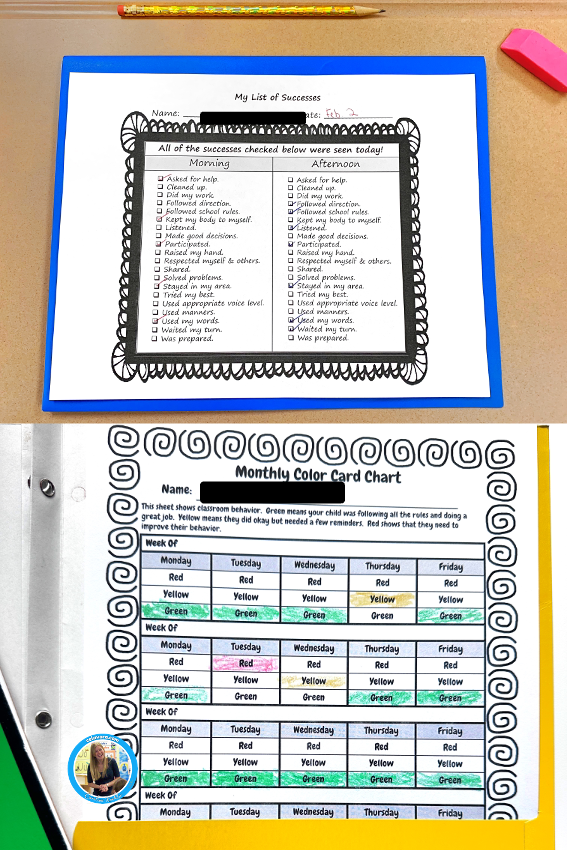
I find behavior sheets invaluable for progress monitoring data.
Either making a copy or taking a picture of the daily charts gives me valuable evidence for IEP goals.
Also, sending the original copy home or emailing a picture strengthens the home to school connection.

Clarify Goals with Behavior Charts
Charts can provide 📈 visual representation of progress and areas that need improvement.
In particular, behavior charts have been shown to provide a clear visual representation the student’s behavior goals.
I make sure that each goal is positively worded and typed on the chart for behavior.
If students are non-readers, I use 🖼️ pictures to support the behavior goals.
Either way, this lets the student and teacher track progress towards goals and to recognize successful behavior changes.
Also, charts for behavior help identify behaviors that need improvement, as the data can quickly (2 weeks or so) show if supports for the goal are 👍 successful or 👎 not.
With a variety of charts for behavior, a chart can be selected and individualized for each student.
This provides meaningful feedback to teachers, students, and families and offering them the support necessary to achieve success at school.

Pick the Right Behavior Page
When choosing a chart to document progress, it is crucial to choose one that is appropriate for the behavior you want to improve.
Consider 🤔 the type of behavior you want to track and what information you want to gather.
For example, if the goal is to improve a behavior that occurs frequently throughout the day, a frequency chart may be more appropriate.
If the goal is to track improvement over time, a points page may better suit the needs.
Additionally, choose a chart that is visually appealing and easy to understand.
For the student who is a 🕹️ gamer, choose a game themed page.
If a student is in tune with traffic signals, go for a 🚦 stoplight chart.
Have a student who is a 🔨 builder and like making things? Use a Rising to the Top chart.
So, no matter what have a set of behavior charts that you can pull from.
All kids are different and charts for behavior need to match the student’s need and personality.
This will make it more likely for individuals to engage with the chart and stay motivated to continue tracking progress.
Taking the time to choose the appropriate chart will help ensure success in behavior improvement support.

Establish Behavior Goals
Using charts for behavior improvement support is a highly effective technique that is commonly used in educational, mental health and counseling settings.
One of the 🔑 key steps in using charting for behavior improvement support is setting goals for the individual in question.
Goals should be specific, measurable, achievable, relevant, and time-bound (SMART).
For students with special education needs, I typically use the behavior goals on their IEPs.
Once goals have been defined, it is important to determine the frequency of charting.
Charting can be done on a 📆 daily, weekly, or monthly basis, depending on what works best for each individual case.
It is important to keep in mind that more frequent charting can provide more immediate feedback.
However, less frequent charting may lead to more sustainable progress over the long-term.
Ultimately, the frequency of charting will depend on the individual’s needs and the goals that have been set for them.
Focus on the Student’s Needs
Involve the student in the charting process to increase ownership and motivation.
When it comes to behavior improvement support, involving the student in the charting process can be a powerful tool for increasing ownership and motivation.
I’ve invited several students to help me design a page just for them. 👩🎨
Usually, I start by showing them some in my collection and then we set out to make a chart for behavior just for them.
This often involves drawing up a plan on behavior page and then putting it into the computer.
This allows them to take ownership of their behaviors and goals, as they are actively involved in creation of their behavior chart. ✍️
By involving the student in this process, it enables them to have a sense of control over their journey toward behavior improvement.
In addition to increased motivation, involving the individual in the charting process also allows for increased communication, collaboration, and trust between the student and teacher.
Ultimately, implementing a charting system that entails active involvement from the student can be a valuable tool in supporting behavior improvement efforts.

Be Consistent When Using Charts for Behavior Support
When utilizing charts for this purpose, it is important to remember that consistency is key.
Have the student’s chart for behavior ready to go ☀️ every day.
This increases trust and opens the door to true long term behavior changes.
Collecting accurate and timely data is essential for ensuring that the chart reflects the true progress being made.
Likewise, regularly updating the chart is necessary for maintaining the most current information and tracking trends over ⏰ time.
Inconsistencies or gaps in data can skew the results, making it difficult to accurately assess progress and make data-driven decisions.
Therefore, it is crucial to establish a consistent data collection and chart updating process.
This may include establishing a regular schedule for data collection, utilizing consistent methods for recording data, and establishing clear expectations for those responsible for collecting and updating the chart.

Behavior Charts = Positive Reinforcements
Using positive reinforcement and incentives is an effective strategy for behavior improvement support that can help individuals achieve their goals.
One way to implement this strategy is by creating charts that 📉 track progress and incentivize positive behaviors.
When goals are met, it’s important to acknowledge these accomplishments with positive reinforcement, such as verbal praise, tokens, or other rewards.
By doing so, you can help 💪 strengthen the individual’s motivation to continue making progress towards their goals.
Incentives can also be used to reinforce positive behavior, as individuals are more likely to continue exhibiting the desired behavior if they know there will be further rewards for doing so.
When creating a behavior improvement support plan, it is important to consider the individual’s personal preferences and interests to ensure the incentives are relevant and meaningful to them.
Use a student interview to ask the student what they want to work for. 🥇
Also, a teacher can give the student a list of rewards and incentives and have them choose what they are interested in.
Overall, implementing the use of charts for behavior improvement support that incorporate positive reinforcement and incentives can be a powerful tool for helping individuals achieve their goals.

Adjust Behavior Charts as Needed
In order to effectively use charts for behavior improvement support, it is important to address any setbacks or challenges that may arise and adjust the chart accordingly.
When recording progress, it is common to encounter instances where a behavior is not improving or may even be worsening. 🤮
This is an opportunity to analyze the situation and determine what factors may be hindering progress.
It may be necessary to adjust the behavior goal or identify additional supports that can aid the student in achieving success.
I like to give a plan two weeks or 10 school days of implementation before I make any big changes. ♟️
Additionally, it is important to work with the student to develop strategies that can help overcome any obstacles that may impede progress towards the goal.
These strategies are often defined in the student’s IEP goals and/or behavior plan.
By acknowledging setbacks and making appropriate adjustments to the chart, we can continue to work towards behavior improvement in a productive and positive way. 👌

Charts for Behavior Are Just One Piece of the Behavior Puzzle
Charts can be an effective communication tool in behavior improvement support systems.
By using a chart, individuals with behavioral challenges and their support systems can 👓 visually track progress towards goals and identify areas for improvement.
One way to maximize the potential of a behavior chart is to use it as a communication tool with other support systems.
This includes but is not limited to caregivers, therapists, and educators.
By sharing the chart with other support systems, everyone involved can stay up-to-date on progress and adjust interventions as necessary.
This can lead to more effective and coordinated treatment plans, resulting in 💫 better outcomes for individuals with behavioral challenges.
I had one family who would proudly post a successful behavior chart at their desk at work.
Colleagues would give compliments to the parent who would relay them to their child.
What an amazing support network that was!
And, yes, in case you are wondering, that student’s chart for behavior was super successful. 😉
Give Behavior Charts Time to Work
Be patient and persistent in using the chart to support behavior improvement.
One of the most important aspects of using charts for behavior improvement support is to be patient and persistent in their usage.
It is unrealistic to expect immediate behavior change simply by implementing a chart. 🛑
It takes time and consistent effort to create new habits and change ingrained behaviors.
Therefore, it is essential to give the chart sufficient time to work.
Also, avoid becoming discouraged if you do not see immediate progress.
Consistent and persistent use of the chart can lead to long-term behavior improvement. ⏳
Additionally, it is important to remain committed to the chart even if there are setbacks or slip-ups.
These are normal and expected, and should not deter you from continuing to use the chart as a tool for behavior improvement.
Never scrap a chart for behavior but rather make small changes as needed.
Try to give two weeks at a time to analyze data to see what needs tweaked and changed. 🙌
Overall, patience and persistence are key elements for using charts effectively in supporting behavior improvement.

Behavior Charts That Work
To conclude, charts for behavior can be a powerful tool for promoting behavior improvement support.
By 🧐 visualizing progress and establishing clear goals, students can gain a better understanding of their behavior patterns
This lets teachers and students make informed decisions to achieve positive behavior improvement.
Furthermore, charts can facilitate communication and collaboration between students, teachers and families, creating a supportive environment for behavioral change. 🤗
Whether used in a school or at home, charts for behavior help have the potential to drive positive outcomes and empower individuals to take control of their behavior.