Positive Behavior Solutions to Calm Emotional Students
As educators, we all encounter students whose emotions can sometimes become overwhelming for them and those around them.
Helping students to feel 😌 calm and in control is an essential part of a teacher’s role, but it is not always an easy task.
Students who struggle with emotional regulation can disrupt the classroom, create negative learning environments, and hinder progress.
However, it is important to remember that every student is unique and has different needs when it comes to emotional regulation.
Therefore, there is 🚫 no one-size-fits-all solution.
However, by understanding the various causes of emotional outbursts and learning positive behavior solutions, educators can create a more positive learning environment for their students.
In this blog post, we will explore the various positive behavior solutions that can help calm emotional students.
From techniques that promote relaxation, such as breathing exercises and self-reflection, to strategies that promote social and emotional learning, such as positive reinforcement and emotional check-ins, we will explore a range of techniques that you can use in the classroom to help students relax.

Happiness with Behavior Charts
Behavior charts for individuals with anxiety or depression like the one in the picture above are meant to encourage them to engage in their 🗓️ days and find the positives that surround them.
Starting with the “My Successes” category and discuss how there are so many successes during their days that they might not even realize certain actions are a success.
Add to the 📝 list if your student can generate any.
Within the “Positive Quote” category, allow your student to look up inspirational quotes or have him or her pick from a set you have complied.
If your student isn’t interested in quotes, this can be changed to 🤣 “Funny Jokes,” “Silly Riddles,” or “Funny Memes.”
To complete the “Physical Healthiness” box, discuss with your student about scanning the body for what feels well and then record with words or drawings.
The idea of this is to help students look for positive physical feelings and associate the body with wellness.
The “Doodle Box” section allows the student a spot to 🎨 draw, scribble, or make any marks.
I often will look at what the student is drawing to see if there are any intentional or unintentional hints from the student about what is upsetting them or what I can do to help them through their trials.
To encourage positivity, teach the “Happy Thoughts” box.
Demonstrate to your student how to record any happy thought no matter how big or small.
The final box, “Kind/Supportive People,” can be used as a list to record any and all people, adults and students, who showed any form of kindness. 💝
“My Smiles” encourages the student and adults to add a happy face into a circle each time the student smiles. This isn’t a “caught” you moment but rather a time for celebration.
Utilizing positive reinforcement
Positive reinforcement is a powerful tool in the realm of behavior management that can help calm emotional students.
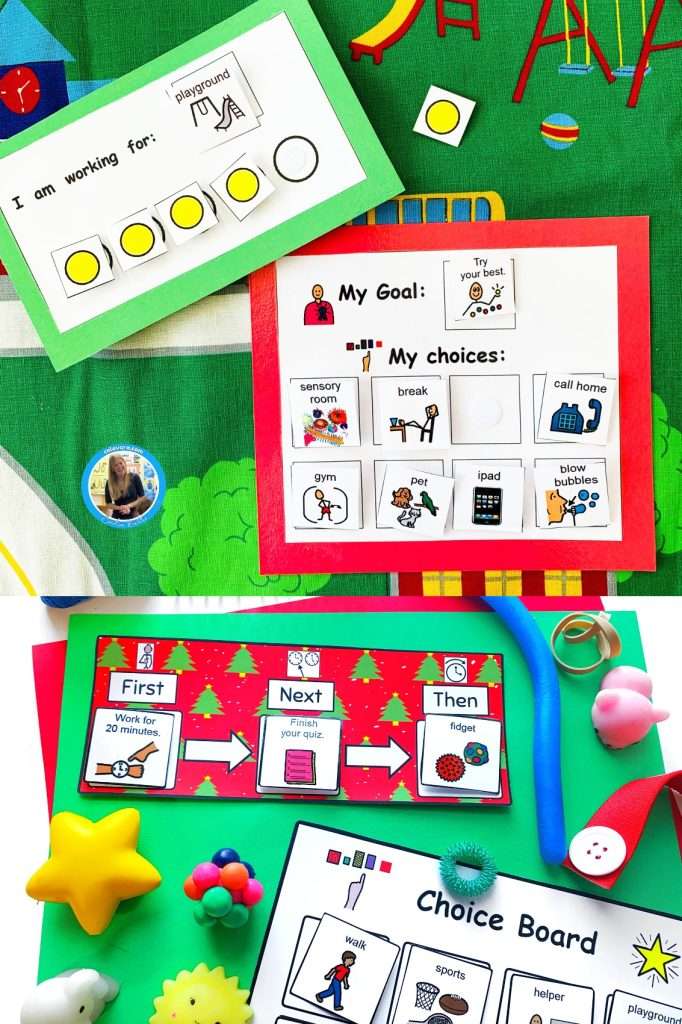
Utilizing positive reinforcement involves 💰 rewarding desirable behavior in order to increase its frequency.
When a student displays positive behavior, such as following directions or completing tasks, it is important to acknowledge and praise their efforts.
This can be done through verbal praise or other positive reinforcement techniques such as stickers, tokens, or a points system.
Students can do this themselves by giving themselves a 🥨 snack reward (gum, granola bar, cookie, etc.) when they are struggling or know they will be struggling.
I’ve written this into many IEPs and 504s and had great success with it.
By consistently reinforcing positive behavior, students are more likely to repeat that behavior in the future.
However, it is important to make sure the rewards match the behavior and are not excessive or unrelated.
Positive reinforcement is a simple yet ✅ effective strategy that can go a long way in promoting emotional regulation and positive behavior in the classroom.

Creating a safe space for students to express themselves
Creating a safe space for students is one of the essential positive behavior solutions to 🤗calm emotional students.
When students are dealing with emotions, it can be difficult for them to feel comfortable expressing themselves.
By providing a safe space, educators can help students feel more at ease and encourage them to open up about their thoughts and feelings.
Communication boards 👉 are excellent tools in this area as are monitoring controls to help with specific topics.
This can be achieved by allowing students to share their thoughts and opinions without judgment or criticism.
Teachers also should acknowledge their emotions and providing validation, and support them in finding constructive ways to cope with their ❤️🩹 feelings.
A safe space can also be created by incorporating activities that promote self-expression, such as journaling, art, or music.
When students feel safe and supported, they are better able to manage their emotions and behavior, leading to a positive and healthy learning environment.

Taking a proactive approach to managing emotions
When it comes to managing emotions in the classroom, it’s important to take a proactive approach.
One effective strategy is to address students’ emotional needs before they become overwhelming.
This can often be accomplished through creating a positive classroom environment that encourages open communication, active listening, and empathy. 🫂
Social stories can be very comforting and helpful for students to prepare them for certain situations.
When reading a story about self-harm to a student once, they responded with, “Others feel this way too?”
I told them that, in fact, yes. I had written this for another student and discussed it with several.
The student expressed 😮💨 relief that they weren’t the only one who had these thoughts.
And even greater relief was expressed that they could overcome these feelings.
Teachers can also use proactive measures such as incorporating mindfulness practices into their curriculum.
Counselors often engage in regular ✅check-ins with students to assess their emotional well-being.
By taking a proactive approach to managing emotions, teachers can help students develop healthy coping mechanisms.
This leads to students with resilience, and a safe and supportive learning environment.

Acknowledging and validating student feelings
Acknowledging and validating student feelings is a crucial component of positive behavior management in the classroom.
By taking the ⏰ time to listen and show empathy towards a student’s emotions, educators can help establish an environment where students feel respected and understood.
Practicing active listening, using open-ended questions, and responding non-judgmentally can help create a rapport with the student and promote a culture of trust and mutual respect.
Validating emotions means acknowledging that every student’s feelings are valid and real, even if the educator does not fully understand or agree with them.
Using a feelings 🔎 monitor can help with this.
Students can use the monitor independently or they can discuss their feelings with a trusted adult.
They need instruction on the types of feelings and how to respond when those feelings occur.
I love doing this in whole and small groups.
Through this approach, students can feel confident in expressing their emotions and know that they won’t be dismissed or judged for doing so.
Ultimately, acknowledging and validating student feelings is a powerful tool for promoting positive behaviors and supporting student emotional growth. 🫶

De-escalating techniques for redirecting behavior
Effective classroom management is key to creating a positive learning environment for both students and teachers.
When dealing with emotionally charged students, it can be challenging to maintain 🕹️ control of the classroom and redirect problematic behavior.
However, utilizing de-escalation techniques can help calm students and redirect their behavior in a positive way.
Very simple, always with you de-escalation strategies are pressure points.
There are 4 🔑 key pressure point areas I like to teach to students:
- The muscle between the thumb and pointer finger
- Hair tugs
- Ear lobes
- On both eye sockets on either side of the nose
Check out the videos in each link to see how to use these pressure point areas as relaxation strategies.
By employing these strategies, teachers can establish a safe and supportive classroom environment where students feel respected, heard, and understood.

Establishing a mantra for emotional regulation
Establishing a 💭 mantra for emotional regulation is one of the most effective positive behavior solutions to calm emotional students.
A mantra is a short phrase or statement that can help a student refocus their thoughts and feelings during periods of intense emotions.
By creating a personalized mantra, students can learn to reframe their negative thoughts into positive ones, reduce stress and anxiety, and feel 🧘♀️ more in control of their emotions.
The mantra can be as simple as “I can do this” or “I am calm and in control.”
Encouraging the student to repeat the mantra in their mind or out loud can help them calm down and regain focus.
It is important to work with students to create a mantra that resonates with them and fits their unique personality to 🏆 achieve the best results.

Incorporating positive activities for teaching emotional regulation
Incorporating positive activities for teaching emotional regulation is an effective strategy for calming emotional students.
Strategies include mindfulness activities such as deep breathing, stretching exercises, and yoga. 🙆♀️
Additionally, creative activities such as journaling, drawing, music, and dance can provide students with a positive outlet for their emotions while also enhancing their emotional intelligence.
I encourage my students to ✍️ write down their frustrations and feelings on notebook paper.
They shouldn’t worry about spelling or handwriting because this is for no one else to ever read.
But students are wary about writing down their most angry thoughts so here’s how we fix that issue.
They write their words on one line and then write over them on the same line. And then repeat.
This turns into multiple words written on top of each other making the writing illegible.
Finally, after they are done, the paper full of gibberish looking scribbles is put in the ♻️ recycling bin.

Utilizing mindfulness and meditation practices
One of the possible positive behavior solutions to calm emotional students is by utilizing 🧎♀️ mindfulness and meditation practices.
These practices offer an effective way for students to self-regulate, manage their emotions, and reduce stress levels.
Mindfulness and meditation also help students to develop a sense of self-awareness, resilience, empathy, and emotional intelligence.
Teachers can incorporate mindfulness practices by starting each ☀️ day with a simple breathing exercise or a guided meditation session.
They can also encourage students to take a few moments throughout the day to pause, reflect, and focus on their breathing or their environment.
My favorite breathing activity involves slow, deep 😮💨 breathing while taking your dominant pointer finger and tracing your preferred shape on the palm of your opposite hand.
This invokes relaxation and can give an overall feeling of peace.
These practices can be tailored to fit the needs of individual students, and can be easily implemented into the school day or at home.
By incorporating mindfulness and meditation practices into the classroom, students can learn to manage their emotions more effectively.
This leads to improved focus, academic performance, and overall well-being.
Developing meaningful relationships with others
One of the key positive behavior solutions to calm emotional students is to develop meaningful 👭relationships with others.
When students feel connected to their teachers and peers, they are more likely to feel a sense of belonging and security in the school environment.
Teachers can foster these relationships by taking the time to get to know their students.
This includes showing interest in their lives outside of school, and actively 👂 listening to their concerns.
This may involve regularly checking in with students, providing opportunities for one-on-one conversations, or setting up small group discussions.
When students feel heard and understood, they are more likely to be engaged in the classroom and less likely to act out emotionally.
Additionally, building strong relationships with peers are also 🌟 important.
Encourage team-building activities and collaboration within the classroom can help students build trust and respect for each other, leading to a more positive and harmonious learning environment.
In conclusion, emotional regulation is a necessary skill for students to learn, but it does not come easy to some.
By implementing positive behavior solutions, schools and educators can create safe and supportive environments.
By acknowledging a student’s emotional state, providing them with resources and coping strategies, and building trust and connection, educators can help students manage their emotions and improve their overall mental health.
Educators who prioritize emotional wellness in their classrooms, better equip students with positive behavior solutions to become successful and confident individuals.