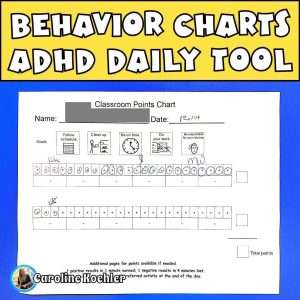
 Behavior Chart Template for Individual Student


Creating Solid Classroom Rules for Elementary School

The most important success factor for a teacher’s school year is to set up classroom rules for elementary school students. Having a good set of procedures and expectations is vital for all productive classrooms.
Teachers need to decide what rules are a must for them to reinforce. Students need to know the limits. When a good set of classroom rules for elementary school is created, success follows.
Classroom rules for elementary school should always be written as what to do. This means positively worded phrases. So, let’s get some examples. I have very little tolerance of students hurting each other. All in all, I don’t want any injuries including no fighting, no smacking, no hair pulling, or any other physical violence.
As a generalized rule for that, I’m not going to say no fighting. I’m going to say keep your body to yourself. Here’s a list of what not to say and what to say.
Use Positive Language for Classroom Rules

Examples of Classroom Rules
When I create classroom rules, I actually end up doing this for the entire school building. As a classroom teacher, the rules that I’ve made follow the students wherever they go. This includes the bathroom, the cafeteria, and the hallways.
Once these classroom rules are decided, I post them in all areas. This does require the principal’s support; however, I’ve yet to find a principal who hasn’t supported me helping students understand classroom rules for elementary school.
When I am discussing rules with students I give them lots of examples of these classroom rules. The posters that I create use clear language and a corresponding simple visual. Just like the male and female outline on a bathroom door that most people see daily, these visuals provide a quick reinforcer.
And we need to keep our students with special needs and individuals learning more than one language in mind when making these rules as well. That’s why simple, purposeful language is so important.

School Rules for Students with Special Needs
One year when I was teaching kindergarten, I had an adorable student with autism who took things very literally. This child had no functional language, but he could read anything I put in front of him. He could follow simple commands but he couldn’t give any commands. For any question that I asked him, he always gave the answer yes.
So, one day it was snacktime and time for him to wash his hands. I was supervising this extremely simple but somehow can turn wild in a kindergarten second task. It was his turn next.
He was standing in front of the sink but a step or two away from the stool. This little step up was needed in order for my kindergartners to reach the water to wash their hands.
In my jolly Mrs. Koehler voice I said, “Jump on up here, buddy.” To which he stood jumping up and down on the floor in front of the stool.
I said, “Oh, I’m so sorry, sweetheart. What I meant was step right up here on the stool to wash your hands.” He stopped jumping right away, stepped up onto the stool, and washed his hands.
Simple, direct language is so important. I value the lesson that this little guy taught me.

Classroom Rules Anchor Charts
Classroom rules are completely natural process to do during back to school time. But, I make sure that rules are revisited regularly. If I’m introducing a new activity, I’m going to start with my classroom rules and procedures. I will refer to my classroom rules over and over again. Many times, I don’t even need to speak! Just pointing at a rule and making eye contact with my students works beautifully.
Coming back from break time, especially winter break? Yep, the first thing on my lesson plan is to review classroom rules for elementary students. I might even have to act out appropriate rules again. That’s why I recommend having classroom rules anchor chart in your areas. The visuals are posted in top spots that can be seen by all.

Create Classroom Rules With Students
Best practice encourages teachers to create classroom rules with students. I absolutely agree with this idea with one caution. First, I have to have a group of students that I can lead to the right answers. If I have a group of students who have never been in school before, they might struggle with this task.
A teacher can still make classroom rules with the students she just might have to provide a lot of examples for them. For instance, a teacher might say, “Would you feel safest in a classroom where others keep their hands to themselves or where you could be touched in a way that hurts?”
When I create classroom rules for elementary students, I always have my idea of rules ready to go. But instead of throwing out my ideas, I ask the kids what they think would be an important rule for a classroom. Calling on students one at a time allows the group to identify procedures that would help us all feel safe, comfortable, and in a state of learning.
I write the rules down on a large piece of chart paper using as much as the students’ vocabulary as possible. Wording the sentences positively and in simple context is also a strategy I use.

The Importance of Classroom Rules
Years ago I learned the simple fact that when a child’s behavior is out of control that moment is not a teachable moment. This is a moment crisis. It’s a time where the only important thing is to return to a state of calm and relaxation. The flat out truth is that when a student feels out of control, unsafe, and/or unclear on classroom rules and expectations, learning does not happen.
Of course, students are going to push the rules sometimes. They are also going to challenge the rules sometimes. That’s not even just okay, it’s good. I want free thinkers in my classroom to challenge the status quo.
However, I need all students to agree that almost every situation is best if I am keeping my body to myself in a safe and appropriate manner. When I create this rule I absolutely talk about the exceptions.
If someone is choking, I can help them. They were not safe and I was trying to use my body to help them. If someone falls down, I can use my body to help them back up if they want that help.
But, I should not use my body in a way that hurts and is purposefully unsafe. With a classroom full of students who understand classroom rules, academic learning can and will happen.

Elementary Classroom Rules and Procedures
When writing procedures and classroom rules for elementary school, I aim for five to six solid rules. In my self-contained class for students with exceptional needs, I created six simple rules.
- Be safe.
- Do your work.
- Accept directions.
- Do what teachers say.
- Accept help.
- Use positive words.
As teachers, we are in the classroom making sure our students are learning. The most important thing to teach our students is appropriate social behavior. This is the tool to promote success and turn a child into a productive citizen.

Back to School Procedures and Expectations Google Slides
Share back to school procedures and expectations with families at open house night. Send a back to school procedures and expectations Google slides link to your students’ parents and guardians.
The take home classroom rules for elementary school gives families a clear understanding of how I run my classroom. This can really help in the long run as it provides parents with an idea of what I’m striving for in my classroom.
Open this time up to allow parents to ask questions. Telling parents how much I would appreciate them reinforcing school rules at home is a must. I have some paper copy print offs of the classroom rules for elementary school for parents to take home if they like.
Making sure that I have copies of my rules already up and posted in the classroom and the other areas that I am enforcing around the school is also very important.
Now – a word to the wise. This especially applies to my secondary and upper elementary school teachers. As a middle school teacher, I started adding a final rule to my list.
Obey All School Rules
I never waste my time having a classroom rule about dress code. But if you’ve ever been a teacher in a secondary building, you know what a big deal dress code is. Parents are often looking for loopholes or inconsistencies in rules throughout the building.
To keep life flowing along peacefully, I add, “Follow all school rules,” to my classroom rules. This is simple and final. At my school district, students electronically sign off stating that they have read and understood all school rules. Simple is best. Documentation is even better.
Alright, time for you to get your classroom rules posted! Grab the sticky putty and post those classroom rules for elementary school in a primetime spot!


