


Positive Behavior Support and Intervention
Positive behavior support and intervention strategies are any type of tool that motivates a student to learn.
Gone are the days of looking towards punishment to fix or change behavior.
Instead, school staff can give a student a better school and life experience by using the best practices to find from IDEA in 1976.
This document was the first to truly promote positive behavior management and rewards for students with special needs.
Of course, positive behavior support and intervention is not just for students with special needs.
However, students with special education needs and IEPs need direct instruction and support than the general education student.
As educators, it’s our job to help the students find success.
A list of effective behavior management tools that allows this to happen. I suggest every educator has a collection to pull from quickly and easily.
At this point in my career, I have a large collection positive behavior support and intervention tools. Here is a list of my top 16 behavior support items.
- First Then Boards
- Daily Visual Schedules
- Behavior Contracts
- Behavior Charts
- Social Narratives
- I’m Working for Boards
- Think Sheets
- Behavior Reinforcer Cards
- Classroom Control Cards
- Visual Monitoring Controls
- Check In Check Out Pages
- File Folder Activities
- Social Scripting
- Communication Boards
- Reward Charts
- Procedure Posters

What are some behavior intervention strategies?
There are so many different behavior intervention strategies. I recommend that you pick a few to start with. Then, try them out to see if they work for you and your group. Here are a few of my favorites.
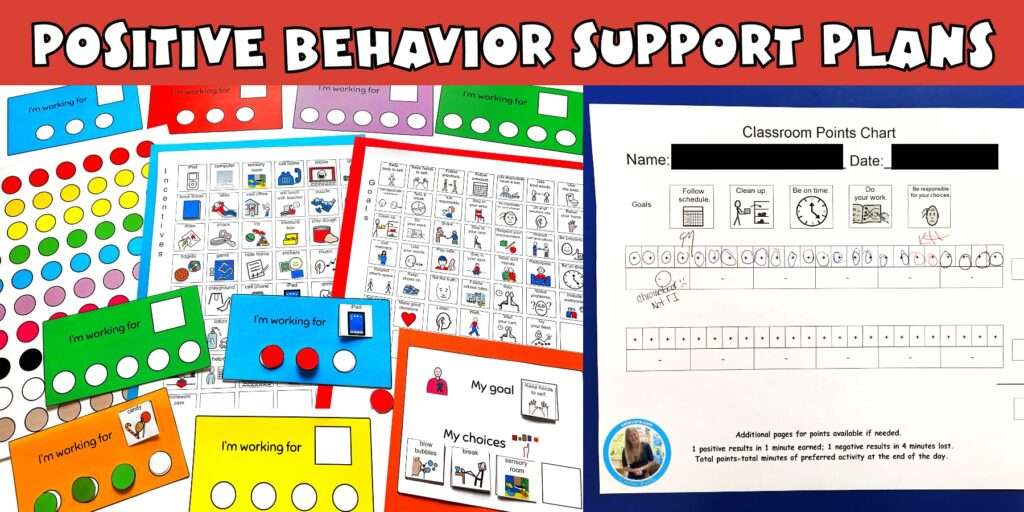
Points Pages
This behavior intervention strategy focuses on one to five goals that the student is working on.
Whenever they are displaying appropriate behavior in these areas, they’re given a positive mark.
These positive marks add up and allow students to receive a reward that they have previously chosen. This could be the gift of time or a tangible reward.
I absolutely love using these points pages as a way to earn minutes.
If a student learns 24 positive points in a day, I will reward them with 24 minutes doing their preferred activity. This is usually computer time.
Behavior Reinforcer Cards
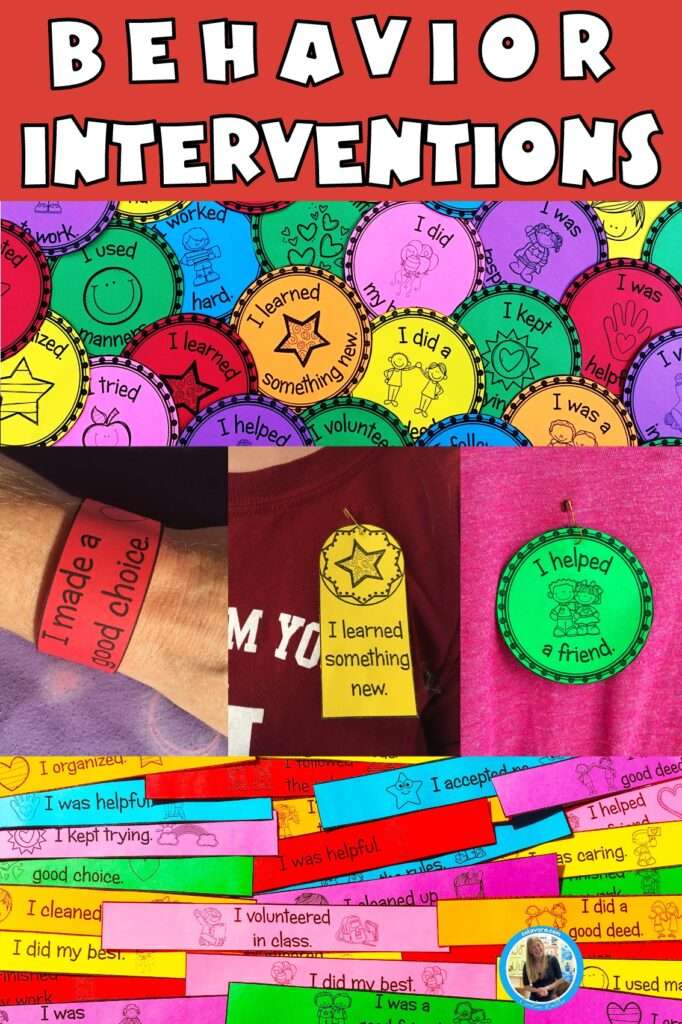
These positive behavior support and intervention cards are super fun and easy tools to use from kindergarten to high school.
Behavior reinforcer cards created like business cards and passed out in a similar manner.
If a teacher or any staff member sees a student being responsible, then a responsible card is given to that student.
Obviously the categories for these cards are nearly limitless. But, my favorites listed below.
Did your best card
Great attitude card
font ask card
Good friend card
And these don’t have to be cards either! I’ve also turned them into bracelets, headbands, and badges.
Classroom Control Cards
Classroom control cards are similar to the behavior reinforcer cards except they are aiming to correct a behavior instead of reinforce it.
Let’s say that you’re working with a small group of students and another student comes up for your help.
It’s obvious that it’s not an emergency but that they truly do need your support. The teacher gives the student in need a Wait Card.
Once the teacher is available the student presents the card and redeems it.
This helps the student get the help needed with a slight delay.
I absolutely love using the Raise Your Hand card in class.
If I have a student who’s blurting out, I do not engage them verbally.
Instead I walk over to their area, hand them a card or place it on their desk.
Then I wait for them to raise their hand. It works like magic! And reinforces hand raising without passing out cards.
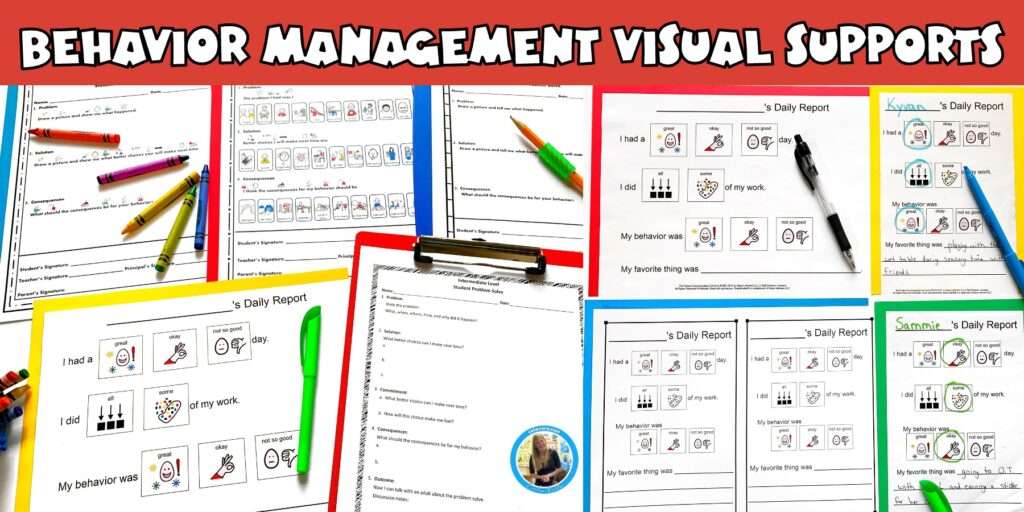
Daily Report
Often I need to communicate in a quick way with parents and guardians at home.
I find a daily report is so helpful in this area. It lets me document successes of the student and keep the lines of communication open between myself and a family.
First Then Boards
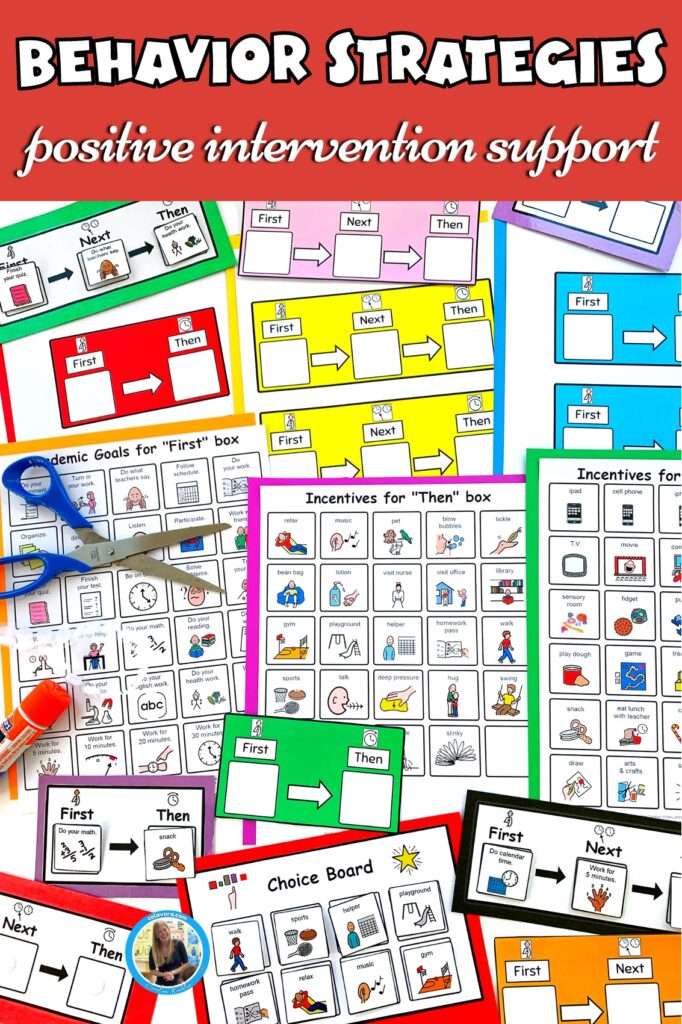
First then boards are an extremely simple tool defining what the student must work on first and then what their reward will be.
There are multiple different ways to use these positive behavior support and intervention boards, but the goal is to allow the student to see and understand what is happening.
I highly recommend these for non-preferred tasks so the student can be rewarded with a preferred task immediately afterwards.
I’m Working for Boards
I’m working for boards are similar to first then boards except they do not have the task defined.
Instead the student is given a board with anywhere between one to five token places.
Once the student demonstrates positive behavior which is defined on a goal board, they receive a token.
Once they fill up their I’m Working for token board, they are given their reward immediately.
Think Sheets
Think sheets are an amazing tool to use if there has been a problem with a student’s behavior.
These are more of a behavior remediation tool that helps the student problem solve the event.
I love this tool as it supports reflection and growth.
They are also wonderful for documentation and goal reporting.
What is an example of positive intervention?
Positive intervention focuses on rewarding a student for good behavior instead of punishing them for bad behavior.
To do this, I use a reward menu. Oftentimes, when I ask a student what they want to work for, they aren’t sure.
When I give them a list of common rewards, they have more direction to choose.
I typically ask the students to circle 5 or so rewards they are interested in. Then, I keep this in their portfolio for easy reference.
Here are the top five most commonly chosen reward:
- Computer time
- Free time
- Gross motor time/gym time
- Snack/candy/drink
- Spending time with class pet
Behavior Interventions
A few years ago, I had the biggest collection of behavior goals for my group of special education students ever.
Out of the 23 students I was teacher of record for, 17 of them had behavior goals.
Math tells me that a whopping 74% of my caseload needed behavior interventions.
But the issue was, I didn’t have a positive behavior support and intervention program.
All I had was behavior goals and progress monitoring sheets to report out on.
My students absolutely need support during and after a behavior issue, but what about teaching them coping skills beforehand?
I spoke with several sped teachers and they all said the same thing: No, we don’t have anything to use to help them before the problem. We only have coping skills that we give them afterwards.
Ugh. That wasn’t going to do.
So I set out to create a behavior intervention program.
The students’ with behavior goals met weekly in groups of about five students.
We discussed topics that had really happened with students I’d had in the past.
The group discussed how to handle the situations.
This included positive reactions and negative reactions.
Then coping skills were discussed and acted out.
The positive behavior support and intervention groups are a thing of beauty.
If you have any students with behavior goals, start your interventions ASAP.

Positive School Wide Behavior Support
The climate of a school is going to make or break the positive behavior support and intervention plan.
As a whole, the staff must be working together to positively affects students’ behavior and education.
To do this, I implemented procedure posters.
These colorful visuals are displayed in every classroom and throughout the building.
Each teacher reinforces them and uses them as the basis for their classroom rules.
Each procedure poster is worded positively and tells students what to do, not what not to do.
I also actively use a ginormous set of visual monitoring supports.
These too should be used building wide so that the students are familiar with them and the staff is reinforcing the same skills.
Favorite monitoring controls of mine include

Positive Behavior Support in the Classroom
Positive behavior support can also be implemented directly in the classroom.
I love doing whole group time. Having all of the little ones together on the rug is a thing of magic.
My go tos for whole group time are calendar, counting, music & movement and behavior support.
This is an excellent time to teach behavior coping strategies and carry out activities for SEL support and self-regulation.
I created a social emotional calendar that focuses on coping strategies.
Each strategy is either free or super cheap.
Using these calendars, I incorporate one activity a day into group time.
I also send these home for families to use as well.
Truth be told, I benefit as well. And I tell the kids that, too.
Positive Behavior Support Plan
Sometimes students might need a little extra support for challenging behaviors.
Students with special needs often undergo a functional behavior assessment (FBA) if their behaviors have shown significant decline or a lack of response to the positive behavior support and intervention.
Because of this, I developed a FBA that outlines the students’ needs along with positive supports to help them improve their behavior.
This is also found in student crisis plans.
Mental health in schools seems to be on the rise and many students are requiring emergency crisis plans.
When writing a crisis plan, I make sure to include what a student’s triggers are along with the positive behavior supports to help during this emergency.
Positive Intervention Behavior Support
Positive intervention behavior support can be as easy as providing visuals to enhance a student’s learning.
A visual daily schedule helps all students, including those with autism, anticipate the events for the day.
This helps reduce stress as the person can mentally prepare for the activities ahead.
Visual cue cards are also another super simple tool to support behavior.
I have my cue cards on a metal ring and can easily flip through the cards to find the one I’m looking for.
Using the Good Work! card is very effective during quick work time.
I also love using the Pay Attention card when students are off task during a lecture period.
Look through your behavior management collection and decide if all of your tools support positive behavior support and intervention.
When searching for more tools, check out Caroline’s collection of resources here.


