Arguing vs Disagreeing Conversational Skills
Recently I received a question regarding my arguing vs disagreeing self-regulation visuals.
Here’s what the kindergarten teacher said:
“I am curious and excited to use them and I want to make sure I use them in the most effective way with my students.
Honestly, each year after covid, I’ve been encountering more and more children with needs that baffle me.
There have been a lot of needs that require a lot more counter-intuitive and more work-around (to me) approaches to meet.
I’ve been told to provide more visuals to my students who are unable to transition, work or follow directions/class routines.
So here I am, a general education K teacher, first time figuring out how to integrate more explicit visuals into my classroom and fearing I might use them in a way that is shaming. (I’m thinking this because I worry bringing something new to only select children might make them feel called out or shamed).
I think I may need some coaching on this apprehension I have and believe I may just need more perspective on how to introduce this new tool to children that is responsive and appropriate and supportive to all students in my classroom.
My next question is that I would love for you to explain the different pages in the set and when you might pull them out and how to help my student use it as a tracking, reflection and self-reg tool.
The arguing that I’m experiencing with this student happens when I set a limit with this student or during choice time with a peer.”

Arguing vs Disagreeing in Student Power Struggles
I’ve added my response to her question below along with additional questions she sent me.
Please use our conversation to help stop arguing in your classroom.
Here’s what Caroline responded:
Yes, I completely understand what you’re saying about the changes after Covid.
It’s so hard to be a general education teacher and accommodate for all the needs that continue to grow.
But the monitoring skills can truly help. First off I have them all printed in a binder in plastic sleeves with a little tab on the side for each so I can find them quickly.
I have some of the most popular ones printed as well and stashed around the classroom for easy grabs too.
First, I absolutely recommend this to help you get started.

Student Arguing with Teacher
With your little one that needs the arguing vs disagreeing visual try not to think of it as singling them out but accommodating them for the special need that they obviously have.
Individualized instruction is so important right now, but you can absolutely introduce this visual whole group because lots of kids really will benefit from it.
If you have any kind of book coming up that you’ll be reading to the kindergartners that involves any kind of argument or conflict you can introduce this visual to everybody.
I used to do this really fun thing where I would be doing something on the board in front of my whole kindergarten class and I would make a mistake intentionally.
Then, I would pretend to cry and throw my marker on the floor and act all the silliness.
I never told the kids I was getting ready to do that so they would all be sitting there like wide eyed with big open mouths.
And then I would obviously collect myself and say oh my gosh, how silly was that.
I just misspelled this word or I just made this mistake on the board. Let’s rehearse what I should’ve and could’ve done together.
So you can do this exact kind of thing with any of the visuals.
How to Stop Arguing
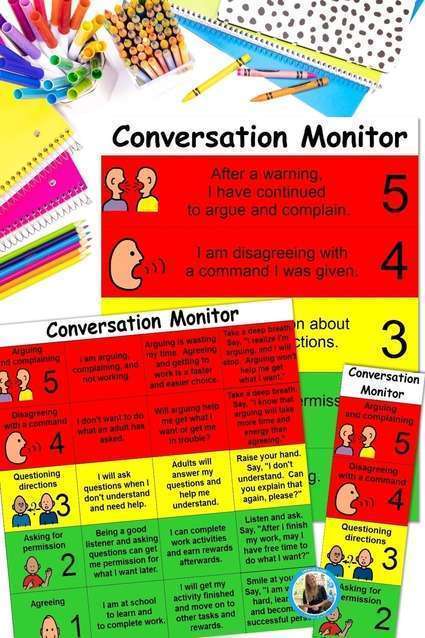
The arguing visual is super easy to use.
You can use it during a book reading and identify different levels within the chart that the characters are involved in.
But with your little one, that’s specifically arguing you’ll want to teach the chart by literally just reading it over.
You don’t even need to say to the student, “This is what you’re doing right now!”
When you first start, print a chart for you.
Print a chart for them after you get done reading the chart.
You could have an additional one cut into five pieces and they’re just laying the pieces on top of the whole chart.
Basically you’re just trying to get them used to the idea of what this chart is and how it looks.
Then you can play a game.
If it’s too hard for the child to admit that they are struggling with arguing then you can role-play.
You can be one character, they can be another character, and those characters can get into an argument.
I like to do the problem first, and then afterwards, the same kind of argument that is peacefully with good strategies.
Then, do the whole group activity with a book.
Apply the same type of concept with this in a small group or one to one using any kind of literature that you have in the classroom that has a conflict or arguing characters.

Teacher and Student Argument Help
Next, during a conflict that the student is actually having get the chart out and point to the icon on the arguing level.
Don’t use any words and see how the student reacts.
Based on their reaction, then you can decide if you can continue using the chart for that first interaction or if a different strategy needs to be taken.
For instance, if the student grabs for the chart and tries to rip it up then it’s a good idea to put the chart down and move to the calming area.
But, if they look at the chart and either visually or verbally engaged, then mirror, what they’re doing and guide them through coming down to a reasonable level of communication.
With kids like this there’s usually some kind of underlying issue and they need help with.
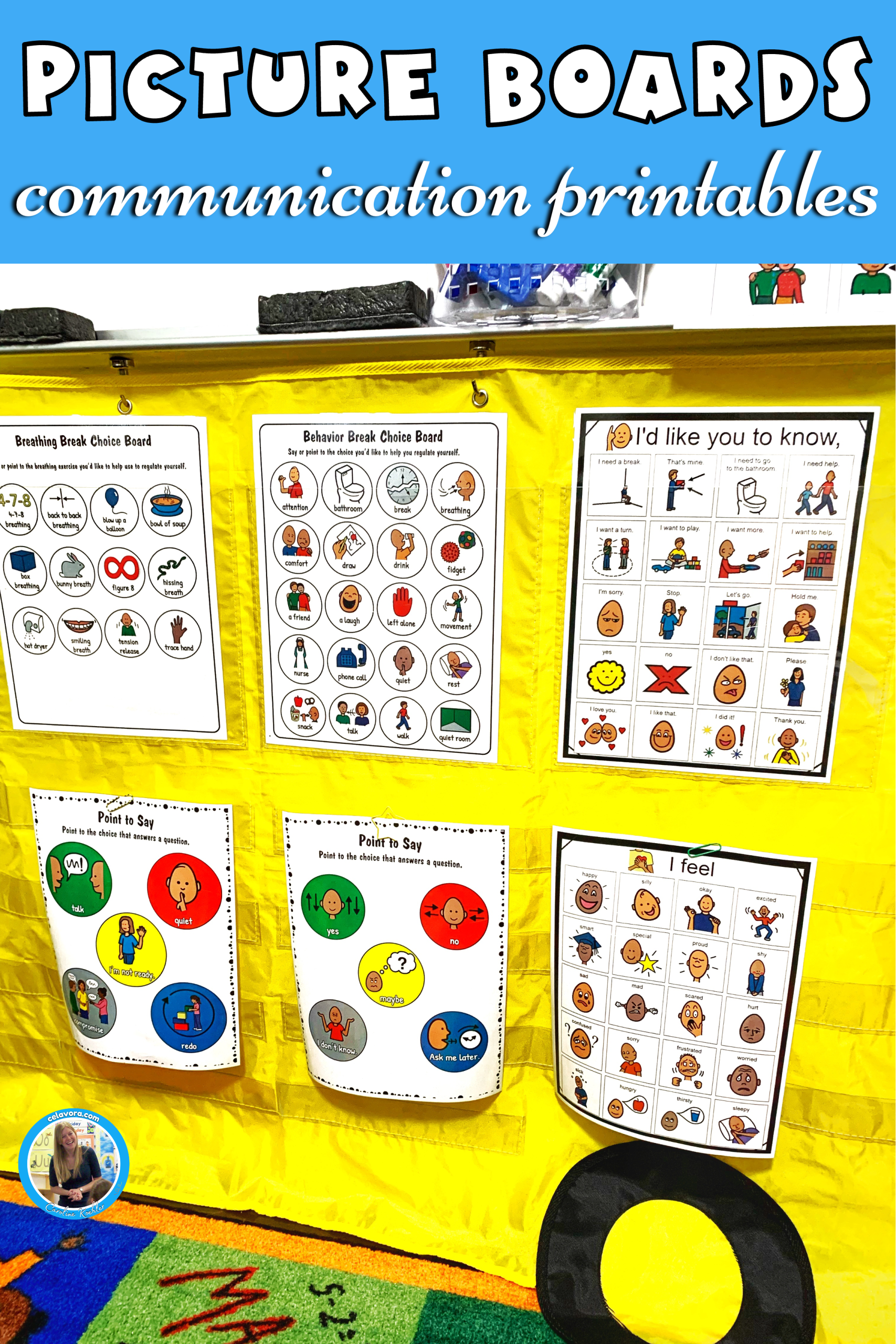
I use communication boards to help with this, a behavior intervention tool that teaches strategies on how to deal with conflicts and one of my favorites that is a behavior coping.
This helps the whole group or individuals or small group to do specific social emotional learning activities to relax and learn how to be a person within society.
Next Teacher Question to Teach Conversation Skills
After reading my response from above, this was the teacher’s follow up email.
“Excellent idea on printing monitor sheets and placing them in a binder. Love the central location whenever I need them! Also, it’s brilliant to start off introducing these tools with a picture book. I can envision taking off with my kiddos. The examples of other ways to introduce it too were so helpful. You definitely gave me a starting point. Thanks!
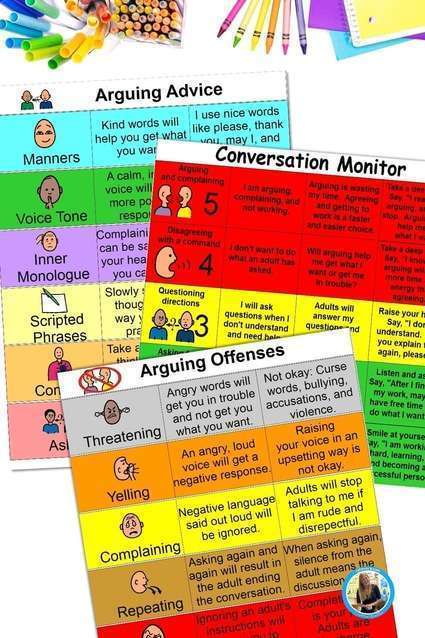
A specific question I have is how do you introduce/use the arguing offense and advice sheets with the children? How do you get them to start understanding how to use them? I’m wondering if the left most column is there to show how arguing can show up in these various forms? The arguing monitor makes sense to me but these two sheets, I’m not quite sure how to go about using them with the kiddos.
In your self-control monitor tool, is the third/right-most column used to guide the child’s next steps/actions based on where he falls on the 2nd column?“

Visual Argument Pictures
Below is my response to this dedicated kindergarten teacher.
Yes, I just literally sit down with the sheet and talk about it.
I do a lot of modeling and then asking the student or students to act it out.
Also, I like having the student reverse roles with me while practicing.
The teacher can be the arguing person and the student can be the adult.
Then, ask them to identify what category you were acting out like manners, voice tone, inner monologue, etc.
Also important to know is that I practice inner monologue constantly in kindergarten: during big book time, during instructions, etc.
I do this by making tons of facial expressions and kind of nodding after I’ve told the students I’m thinking inside my head.
Then, I tell them what I was thinking out loud.
In the beginning, I will mouth what I’m thinking as a further cue.
Also, think about teaching this same chart over and over again.
Not just one time, not just twice, but many times.
This is similar to practicing sight words; the kids need so many different instructions with it and chances to use it especially before a “real” instance.
Arguing vs Disagreeing Support Tools
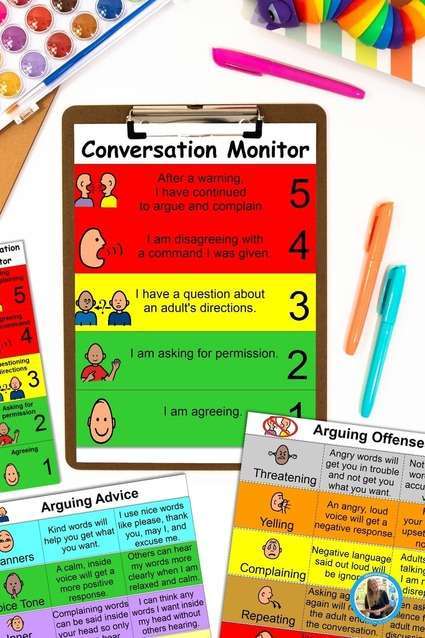
Once you’ve went over both the arguing advice and arguing offenses, put the pages side by side.
Make sure to express that disagreeing with someone doesn’t have to be angry or mean.
I want kids to continue asking questions and having a curious mind.
Talk about how using the arguing advice is more likely to end with positives and getting your way but the arguing offenses is likely to end in a problem and even consequences that they don’t want.
Then, use the conversation monitor as a tool to tie everything together.
I like having all 3 for a student like this when an arguing episode happens.
I use these tools when the argument is going well or it’s a problem.
You can reinforce good choices with the advice page and negate poor choices with the offense page.
Then, use your paperclip or arrow to move to the level that is appropriate on the conversation monitor.

Teach Communication Skills
The teacher also asked about using the self control monitor which I explain below.
For the self control monitor, most young students use the left column the most with adult using the written text in the other columns as a guide.
Verbalize this to the student so they are understanding the images more fully.
Use the far right column to guide your student to their next steps.
I consider this “positive peer pressure.”
If your student is in level 4, you can remind them that the green levels are where people who are keeping their power and making good choices because they are mature.
State that you want to help them get to this level so you can work together to think of a better way to handle this. Some kids (and adults) can’t yet do this alone.
Make sure they know that that is okay because strong people ask for advice and support where as people out of control choose negative thoughts and chaos.
Kinda deep, huh?

Stop Arguing
Arguing is an exhausting way to spend your time.
Additionally, arguing with students leads to tired and cranky people and a lack of focus.
But, teaching arguing vs disagreeing with advice and offenses is a lifelong skill.
Using visuals, role play, and incorporating this into your daily teaching is an excellent way to teach conversation skills.
Whether it’s whole group, small group, or individual instruction, use tools that visual explain expectations.
Keep your patience and visuals handy to help students understand arguing vs disagreeing.