Unlocking the Benefits of Social Skill Autism Supports

Strategies based in research along with technology 🧑💻 tools have made it easier than ever to provide social skill autism supports to individuals on the autism spectrum.
Through visual supports, individuals with autism can gain access to a wide array of resources and services to help them lead their best lives.
With the right supports in place, these individuals can be successful in both their educational and professional endeavors. 🎗️
As autism helpers, our job is to enable them to take full advantage of all the opportunities available to them.
Let’s look some easy but important tools to build social skills supports for those with autism.
I recommend using the visual supports below as advice and resources for those looking to provide these assistance to individuals on the autism spectrum. 🧩

Reinforce with File Folder Activities
When it comes to unlocking the benefits of social skills supports for individuals with autism, one of the most important things to do is to embrace the challenges and use them to grow.
Visual supports are an incredibly effective tool for helping to create an environment in which social skills can flourish.
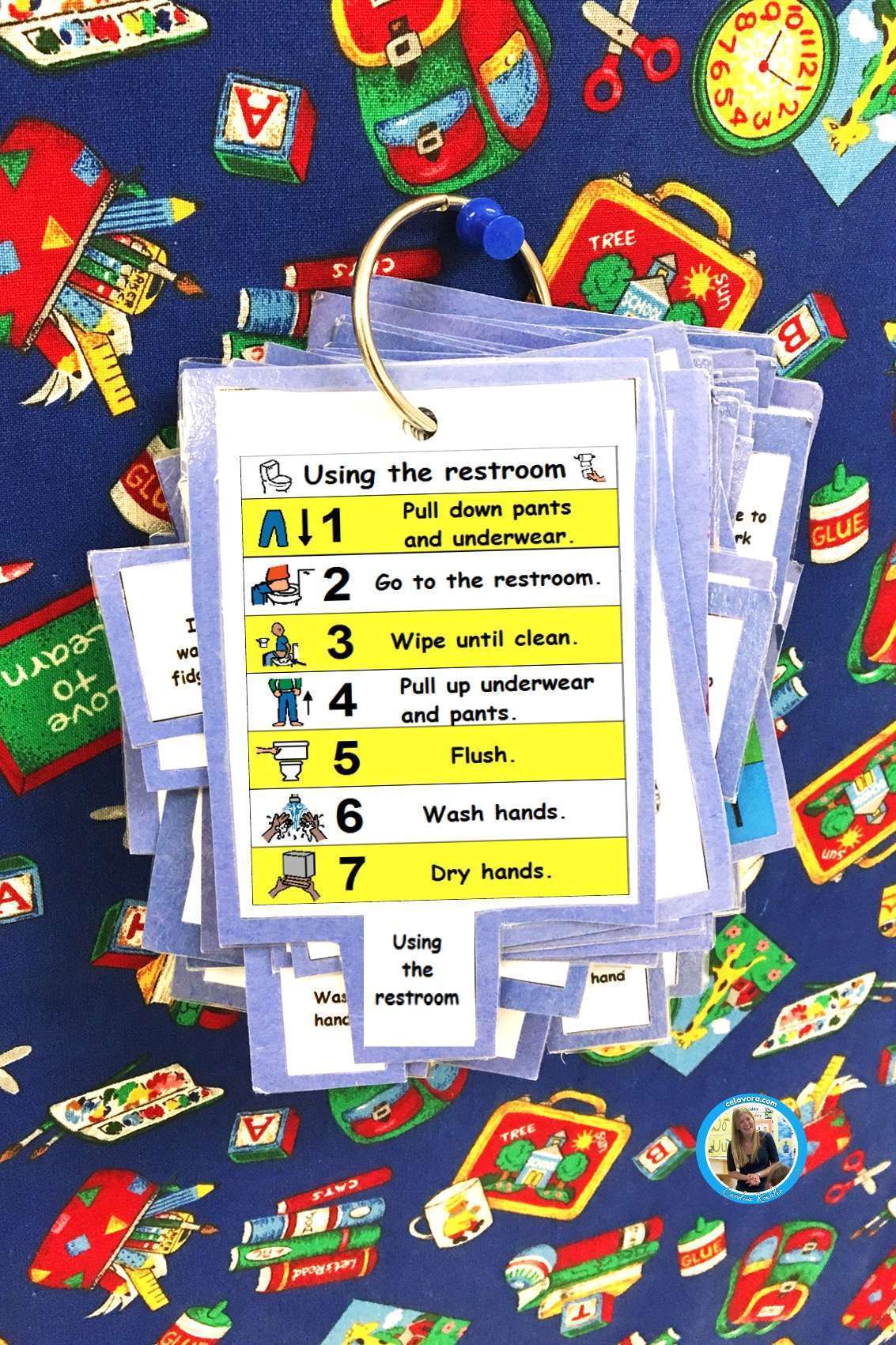
I use 🗂️ file folders in the classroom to first teach and then reinforce social skills and desirable behaviors.
Some of the social skills that I’ve ✂️ turned into activities are
- Control Your Behavior
- How to Talk to Teachers
- What Gets You In Trouble
- What Gets You What You Want
- Good Choices – Bad Choices
- Classroom Rules
- Hygiene Procedures
- Manners
- Things to Say or Not to Say
- Asking Questions
- Being Safe
- Volume and My Location
- Voice Tone
- Emergency Noises
The sky is the limit for creating file folder activities for social skill autism supports!
For example, a reinforcing file folder activity can be used to provide a tangible representation of the rewards that come with developing social skills. ☺️
I would teach an activity, such as sharing, to a student 1-1 or a small group. Then, we would work on a correlating file folder.
Once, I’ve 👩🏫 taught this skill, I’ll work on it at least 5 more times in the small group setting.
Afterwards, I will take the file folder activity and put it the students’ independent work station to continue to reinforce this skill.
This also provides a visual reminder of the progress that has been made.
By using such visual supports, individuals with autism can be 👏 encouraged to take on challenges and use them to grow in their social skills, ultimately unlocking the full potential of social skills supports.

Communication Skills with Visual Supports
Social skills are essential for building meaningful relationships and strong communities. 🏘️
Unlocking the benefits of social skills autism supports is made easier with the use of visual tools.
Visual supports can be used to help individuals with autism to effectively communicate and interact with others.
By using visual supports, such as emotion scales, communication prompts, and point to say boards individuals can develop constructive communication skills.
This is the cornerstone to create meaningful connections with those around them.
Visual supports can also be used to help break down complex situations and events making it 😌 easier for individuals with autism to understand and act upon instructions.
So, in times of high stress, learning new concepts, or un-preferred activities, make sure that communication boards have been taught and are available.
This is important for individuals with autism regardless of their cognitive levels or verbal abilities.
When emotionally charged situations occur, they need visual tools in place to 🙏 support their social skill autism needs.
Visual supports are an invaluable tool for unlocking the full potential of social skills autism supports.

SEL Supports with Behavior Coping Strategies
Unlocking the benefits of social skills autism supports can be a challenging but rewarding journey.
By practicing social emotional learning with behavior 🧘♂️ coping strategies, children with autism can begin to recognize and process their emotions.
So, that sounds great but how do we do that, right???
It starts with purposeful and explicit teaching.
You know how many schools have small group instruction for 🧮 math and 📚 reading?
We need the same thing for social skill autism support.
I created a behavior intervention set with list of rules and ways to respond to typical behavior issues.
Common social problems that those I’ve known with autism have had in the past are featured on cards with supporting pictures.
A student or a small group and I read the cards and discuss possible real life responses. 🛟
Then, we talk about what would be the worst response, an okay response, and the best response.
This increases their social skills along with their ability to understand the social cues that come with interacting with others.
Visual supports can be incredibly effective in 🫶 helping children with autism to understand and practice social skills.
By exploring the variety of social skills autism supports available, children can gain the confidence and understanding to develop life-long social skills.

Engage in Conversations and Practice Responding Using Cue Cards
For individuals on the autism spectrum, 🗣️ conversations can be an overwhelming experience.
This is why it is important to support them with social skills and visual supports.
Cue cards are an excellent way to help autistic people engage in conversations, as they can provide visual reminders of the topics they want to discuss and the words they need to use.
With cue cards, they can practice responding to ❓ questions and learn the skills they need to take part in conversations in a pressure-free environment.
The development of social skills is an essential part of life.
Unlocking the benefits with autism supports can make a big difference.
Definitely, give cue cards a try!

Use Social Stories
One of the most effective social skill autism supports is the use of social stories. 📒
Social stories are visual supports that feature a narrative to help those with autism or other special needs better understand social situations.
They provide a visual support that can help explain typical social situations and the expected behavior of others.
By reading a social story, those with autism can gain a better understanding of what is expected in a particular situation.
Also, social stories can provide a more concrete way of understanding social cues and expectations.
With the 🤲 help of social stories, those with autism can learn how to respond in challenging social situations and make progress in their social skills.

Use Communication Boards to Express Feelings, Emotions, and Self-Regulation
Communication boards are one of the most effective social skills autism supports used to help individuals with autism express their ❤️ feelings, emotions and enhance self-regulation.
Using visual supports such as a communication board helps foster a sense of independence for the individual and gives them an opportunity to communicate more effectively.
For example, a communication board can have pictures, symbols or words that represent the individual’s feelings, needs and wants.
This visual support can be used to help individuals with autism to express themselves more effectively and to better engage in social settings.
These can be made specifically for a person’s 🧸 needs and interests or a typical “wants and needs” board can be use.
I love these because they pull out anxiety related to vocalization.
They are fast, efficient, and super effective at helping someone be heard even without saying a word.
Communication boards can be an incredibly 💪 powerful and inspiring tool in helping individuals with autism to increase their social skills.

Teach and Use Visual Monitoring Scales
Visual monitoring scales provide an important social skill autism support for a person on the spectrum to keep ✅ track of their performance in different social situations.
Visual monitoring scales can take on almost any topic and show the different levels to a person with autism.
For example, a person may use a scale with five levels of performance.
These are often 🌈 colorful with the colors of a stop light showing up throughout the levels.
I’ve created several that are also spectrums of gray as behaviors often glide across a gray scale in society.
Some of my 🌟 favorite 🌟 monitoring controls include
- Volume
- Stealing
- Lying
- Speed
- Manners
- Self-Sabotage
- Stress
- Voice Tone
- Manners
- Respect
- Touching
- Perception vs Reality
- Feelings
- Wellness
- Winning vs Losing
This could show a picture of a person with a finger over their lips and the word “Quiet” at the bottom, and a picture of a person with their mouth wide open appearing to show and the words “Very Loud” at the bottom.
This visual representation can help the person 🧐 learn to recognize, identify, and understand different levels of social performance.
Then, they can translate how their actions affect their overall performance in social situations.

Utilize Social Scripting
Social scripting is one of the most powerful and effective autism supports available to help people with autism develop social skills.
It involves breaking down social interactions into smaller, visual 🪜 steps that people can practice and learn.
This is a slight twist on social stories but is a bit more direct.
I’ve used this with students who script a lot or continually say the same things over and over again.
This is done by creating a topic, then adding in a question or statement with appropriate and inappropriate responses.
The responses are 📣 discussed and then the appropriate response is practiced and modeled multiple times.
Social scripting can be used to help individuals understand social norms, build confidence, and increase empathy.
It also provides a safe 🏚️ space and visual supports to help people with autism better understand how to navigate social interactions.
By utilizing social scripting, people with autism can unlock the full benefits of social skills and enjoy a more meaningful, connected experience with those around them.

Increase Self-Esteem and Confidence with Rewards and Incentives for Goals
Unlocking the Benefits of Social Skills Autism Supports is all about helping those with autism to reach their goals in 🙌 life and feel confident in themselves.
One of the best ways to do this is to give rewards and incentives for attaining goals.
Visual supports can be an incredibly helpful tool for boosting self-esteem and confidence, as they provide a visual reinforcement when goals are achieved.
I use rewards and incentives for almost every single behavior goal and that includes social skill autism building. 🏆
Tools that I often put to work in this area are
- First, Then Boards
- First, Next, Then Boards
- I’m Working for Boards
- Behavior Charts
- Reward Charts
- Behavior Contracts
- Check In Check Out Pages
Rewards and incentives can also provide an extra boost of motivation to help individuals with autism reach their goals.
Remember, rewards have to be what the student wants or there won’t be enough motivation for them to change their behavior. 🏅
By providing rewards and incentives for goals, you can increase self-esteem and confidence, and make social skills autism supports that much more powerful.

Social Skill Autism Supports
it is clear that understanding and unlocking the benefits of social skill autism supports can be a great asset to those with autism. 🤗
This can help to improve communication and social interaction, increase self-confidence, and create more meaningful relationships.
With the right support and resources, individuals with autism can 🔑 unlock their full potential and live their best life.
Be the helper who makes social skill autism supports a reality and a success in a person with autism’s life by using the visuals above!