


Autism Meltdown Support Strategies
Navigating the complexities of an autism meltdown requires an understanding of the emotional and sensory challenges individuals may face.
All of these challenges and more lead to an autism meltdown.
An autism meltdown is a response often triggered by overwhelming stimuli or unmet needs.
This can significantly impact the well-being of both individuals with ASD and their support networks.
Recognizing the signs of a meltdown along with using effective support strategies, is essential for safety.
Below are tried-and-true strategies to support individuals during meltdowns.
All emphasize the importance of proactive measures, effective communication, and sensory accommodations.
The goal is to create a more empathetic and understanding atmosphere that not only minimizes the occurrence of meltdowns but also aids in the recovery process.
These strategies aim to empower individuals with ASD.
Caregivers can also benefit by helping them navigate their emotional landscapes while enhancing their quality of life.

Visuals Communicate Feelings
Incorporating visuals into communication can be a game-changer for expressing emotions, especially for individuals who may struggle with verbal expression.
Tools such as emotion charts or pictorial aids can help convey feelings in a clear and accessible manner.
Some of the most useful autism meltdown aids include
- cue cards
- posters
- leveled scales
- social stories
- charts
Individuals can better identify their own feelings using these visual supports.
Ultimately, this leads to improved emotional regulation and reduced anxiety during challenging situations.
Use visuals that are worded positively and tell those with autism what to do.
Here’s an example of what to do:
Keep your hands to yourself.
Here’s a negatively worded example of what not to do:
Don’t hit people around you.
Visuals are often beautifully laid out graphics from a computer.
I prefer Mayer-Johnson’s Boardmaker to create visuals.
However, you can handwrite or draw on anything.
The main point is to use visuals to aid in understanding, not to look cute.

Social Stories for Understanding Situations
Social stories are helpful in navigating social interactions with an increased understanding.
By tailoring social stories to specific situations, individuals can better prepare for what to expect and how to respond appropriately.
This includes
- changes in routine
- social gatherings
- unfamiliar situations
- activities with known triggers
- areas of difficulty or challenge
- multi-step directions
- unspoken societal rules
These narratives serve as a guide.
Their purpose is to break down scenarios into manageable parts.
Then, they provide clear expectations as a way to reduce anxiety and confusion about the unknown.
Incorporating social stories allows for practice and discussion of real-life situations.
This gives individuals the tools and language they need to express themselves effectively.
This proactive autism meltdown approach not only fosters understanding but also empowers individuals to develop their social skills through repetition and reinforcement.

Behavior Calming Interventions
Creating a calming environment is essential for individuals experiencing heightened emotions or sensory overload.
But, unfortunately, an autism meltdown is not a teachable time.
Have you ever tried learning a new skill or strategy while you are feeling wildly out of control?
I sure haven’t!
But what you can do is set out to learn new strategies to use when an autism meltdown happens.
Schedule in a behavior intervention skill building time.
I cannot stress this enough: teach how to prevent, calm, and recover from an autism meltdown.
This could include using a communication boards with coping strategies can serve as an effective strategy for providing visual cues that guide individuals through calming techniques.
Use deep breathing exercises, visualization prompts, or sensory breaks.
Additionally, integrating visuals that outline calm-down strategies can be beneficial.
These can be displayed in accessible locations and tailored to the individual’s preferences.
Complementing these strategies with behavior interventions can further reinforce positive behavior.
Together, these tools create a comprehensive support system that encourages self-regulation and emotional resilience.
By teaching a variety of strategy, individuals can select their preferred calming method when the time comes.
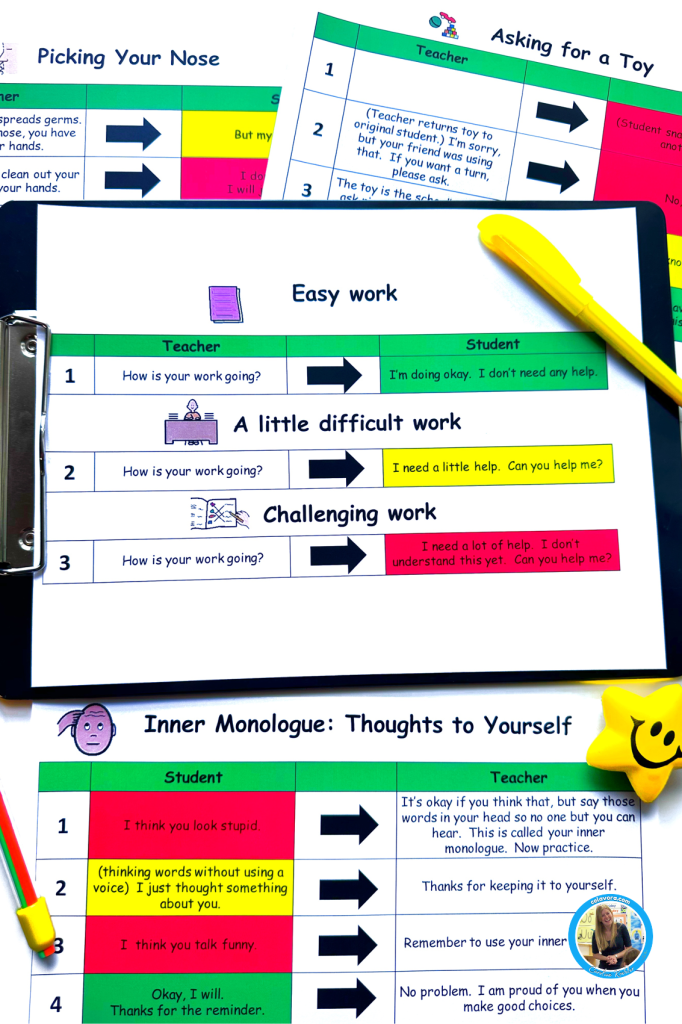
Social Scripting for Autism Meltdown
If you have or work with individuals with autism, you might notice there is a phrase they enjoy a lot.
Below are phrases that make me smile as I associate them with individuals with autism who I adore.
- I like to move it, move it.
- To infinity and beyond.
- Let it go; let it go.
- I am groot!
- ba dum ba ba baaaa I’m lovin’ it.
- Don’t forget to like and subscribe.
- Game over.
This is social scripting compliments of movies, TV, video games, and social media.
But since we know that some individuals with autism are drawn to scripting, we can use it to help.
Incorporating social scripting into daily interactions can greatly enhance communication skills and ease social exchanges for individuals.
Social scripts provide structured frameworks that outline appropriate responses in various situations.
This makes it easier for individuals to navigate conversations and social cues.
So, work on social scripts during 1-1 or small group time.
Practice an “If I say _, then you say _.”
By practicing these scripts in a safe environment, individuals can build confidence in their ability to engage with others, reducing anxiety and the potential for misunderstandings.
Utilizing visuals alongside these scripts can further aid comprehension, allowing individuals to quickly recall and implement the appropriate responses during real-life interactions.

Leveled Monitors to Minimize Autism Meltdown
Leveled monitors are some of my favorite visuals.
They have a defined topic that is broken down into 5 categories.
Language, actions, and pictures help explain the topics in detail.
By tailoring these monitoring controls to different topics, individuals can experience success as they work towards more complex social interactions.
Also they providing visual reminders of the levels involved in each interaction.
This aids in clarity and also reinforces learning so it’s engaging and accessible.

Interactive Behavior Boards
Interactive behavior boards serve as dynamic tools to enhance engagement.
They provide a visual and tactile way for individuals to understand and navigate social expectations.
These boards can be vastly different.
Take the Chance Board for example.
Sometimes, an autism meltdown is triggered by not knowing how close one is to “being in trouble.”
That’s why I created this board so that a student could see how many chances were left until a consequence was enacted.
Boards allows for customization based on individual needs ensuring that the content remains relevant and motivating.
A completely different behavior board is a countdown board.
This includes pulling off a token one at a time until an activity is complete.
But, it doesn’t have to be a work activity: you can use this for deep breathing, too.
Two of the most popular interactive behavior boards are First, Then and I Am Working for.
These boards are most effective when a reward has been established and the task at hand defined.
This interactive approach not only keeps individuals engaged but also supports the development of critical thinking and problem-solving skills in social contexts.
Ultimately, by making learning interactive and enjoyable, behavior boards can play a significant role in promoting social awareness and emotional regulation.

Shhh…Quiet. It’s an Autism Meltdown
Create a designated quiet space to managing overwhelming emotions and stimuli.
Tailor this area to the individual’s preferences, featuring calming visuals, soft textures, and minimal distractions.
Incorporating sensory items like weighted blankets or noise-canceling headphones can also allow for effective self-regulation.
Having a consistent and recognizable space can signal to the individual that it’s time to unwind and regroup, aiding in the transition away from distressing situations.
Additionally, utilizing social stories that depict scenarios where retreating to this quiet space is beneficial can reinforce the practice.
These stories can illustrate when to use the space, what to expect, and how it can help regain composure.
Employ leveled monitoring controls with the calm down corner.
Remember that the calm down corner is there to decompress not to be a fun place to play.

Cue Autism Meltdown Coping Skills
Encouraging the use of coping skills during challenging moments can empower individuals to better manage their emotions.
Social scripting can serve as an effective tool, providing clear phrases and responses that individuals can use when they feel overwhelmed.
By practicing these scripts in a calm environment, individuals become more comfortable recalling them during heightened emotional states, allowing for a smoother transition through a meltdown.
This preparation can significantly lessen anxiety, offering a sense of control over the situation.
Coping skills should be taught in a 1-1, small group, or even whole group setting.
Use visual supports that represent different coping strategies, such as deep breathing, counting, or engaging in a sensory activity.
When an individual begins to exhibit signs of distress, they can refer to the board for immediate support, reducing the likelihood of escalation.
By consistently incorporating these strategies into daily routines, individuals can build resilience and the ability to recognize and utilize their coping mechanisms effectively.

Consistent Routines
Establishing consistent routines can provide a sense of security and predictability.
When daily activities are structured in a familiar manner, it helps to set clear expectations, reducing anxiety around the unknown.
Incorporating visual schedules can enhance this stability.
Daily schedules allow individuals to see what is coming next in their day.
By breaking down tasks into manageable steps and presenting them visually, individuals can gain a clearer understanding of their routines, fostering a greater sense of control and comfort.
Allow a student to have their visual schedule regardless of ability or your perceived need.
I once spoke with a teacher who removed a visual schedule from a student because “he didn’t need it any more.”
When I asked her if I could remove her calendar and planning guides since she seemed to be managing fine, she gasp.
The point is without a schedule, one might not be as organized and at ease as they are with a schedule.
By emphasizing stability through consistent structures and supportive resources, individuals can navigate their daily lives with increased confidence and reduced emotional turmoil.

Autism Meltdown Triggers
Identifying triggers is a crucial component of an effective emergency crisis plan, especially for individuals who may struggle with emotional regulation.
Triggers can be specific sensory experiences, social situations, or even changes in routine that lead to heightened anxiety or distress.
By recognizing these potential triggers in advance, caregivers and support staff can develop proactive strategies to minimize their impact.
Use an emergency crisis plan for autism meltdown support.
When writing a crisis plan, consider what would be an absolutely worst day ever.
I’ve had many people reach out to me asking why a crisis plan was so intense.
It’s not because that’s how the student is every day but, rather, it’s because that’s the level of support the student needed during an emergency aka an autism meltdown.
Outline what tools to use and what to avoid.
Make sure to list triggering phrases and what provokes the student.
In addition to monitoring triggers, behavior crisis plans can provide essential support during a meltdown.
Creating a detailed log of known triggers and corresponding strategies to help with responses.
This leads to a safer and more understanding atmosphere.

When Needed – Get Help
Supporting individuals during an autism meltdown requires patience, understanding, and the right strategies tailored to their unique needs.
To do this use resources like visuals, social stories, and interactive behavior boards.
These tools create a supportive environment that promotes emotional regulation.
Implementing social scripting and leveled monitoring contracts can also empower individuals by giving them tools to communicate their feelings effectively.
Remember, every meltdown is an opportunity for growth and learning, both for the individual and their support network.
If you have run out of ideas and options, reach out to get help.
I promise that we have all asked for assistance many times than we can count!
With the right strategies in place, we provide a safe, supportive atmosphere.
We can help navigate challenging moments but also celebrate progress and resilience.
If you need more help, please check out more resources and tools to assist in these efforts at Celavora.


