Behavior Intervention Positive Approaches for Success
Behavior intervention is a vital aspect of promoting positive behavior and academic success in students.
Challenging behaviors address in a proactive and effective manner is key.
Traditional methods of discipline and punishment have proven to be ineffective in promoting long-term behavior change.
Also, they often create a negative and hostile learning environment.
Implementing positive behavior interventions to foster a supportive and nurturing school environment are beneficial for all.
These approaches focus on understanding the underlying reasons for challenging behaviors.
Then targeted support is given to promote positive alternatives.
Through the use of evidence-based strategies and collaboration amongst all stakeholders, behavior intervention positive approaches have shown to be highly effective in promoting social-emotional development, academic achievement, and overall well-being in students.

What is a behavior intervention?
A behavior intervention refers to a proactive approach aimed at addressing and modifying problematic behaviors in individuals.
It involves implementing strategies and techniques to help individuals learn and develop more positive and appropriate behaviors.
Behavior interventions are commonly used in various settings, such as schools, workplaces, and homes.
The goal is to support individuals with behavioral challenges and promote positive behavior.
These interventions can include a range of strategies, such as reinforcement, modeling, social skills training, and environmental modifications.
The ultimate goal of a behavior intervention is to foster growth, self-regulation, and success by providing individuals with the necessary tools and support to improve their behavior and overall well-being.
Utilize an objective student observation
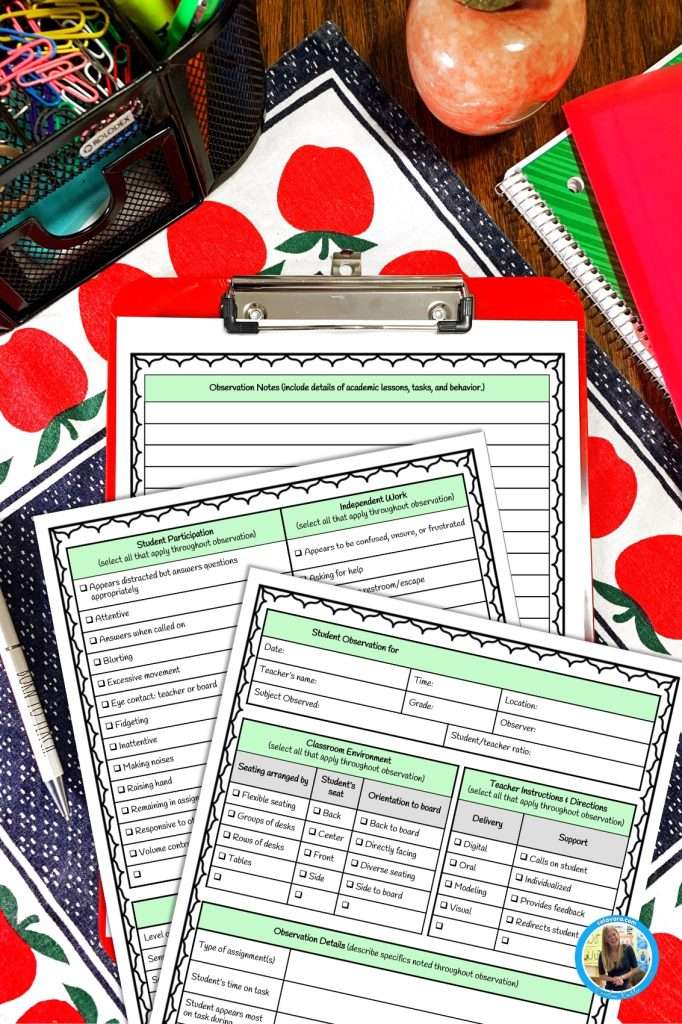
One effective approach to utilize within the framework of behavior intervention is objective student observation.
By observing students in a non-judgmental and unbiased manner, educators and support staff can gain valuable insights into the factors that may be contributing to challenging behaviors.
Objective student observation involves carefully watching and documenting the student’s behavior.
This includes noting the antecedents, behaviors, and consequences that occur in various situations.
This information allows educators to analyze patterns, identify triggers, and develop tailored interventions to address specific needs.
There are 2 ways to record student observations: paper or digitally.
Use a form that insures you are capturing the necessary information.
If you do many observations for evaluations or progress monitoring, save your time by going digital.
SPED Up Paperwork’s system is an online data collection set that takes your information and creates a ready to use narration as soon as your observation is finished.
By utilizing objective student observation, educators can gather meaningful data to inform behavior decisions.

Move on to a functional behavior assessment
To address challenging behaviors, it is advisable to move on to a functional behavior assessment.
This assessment is a comprehensive process that helps identify the function or purpose behind a student’s behavior.
It goes beyond simply observing the behavior itself and aims to uncover the underlying reasons or motivations driving it.
In a student observation, I’m looking for the positives and negatives in behavior.
However, with a FBA I’m only focusing on the negative behaviors what is driving those behaviors.
By conducting a functional behavior assessment, educators can gain valuable insights into factors that may be influencing the behavior.
Click here to see Caroline demonstrate how to conduct a paper pencil FBA.
But just like the student observations, if you are doing functional behavior analysis often, go digital.
Use SPED Up Paperwork’s online tool to help you conduct a FBA and then provide you with a detailed narration as soon as you click submit.
This deeper understanding allows for the development of targeted interventions and strategies that address the root causes and promote positive behavior change.
Using a functional behavior assessment as part of the behavior intervention plan can lead to more effective and individualized support for students.

Create a behavior intervention plan
When working on supporting students with challenging behaviors, developing a behavior intervention plan is a crucial step towards promoting positive outcomes.
This plan serves as a roadmap.
It outlines specific strategies and interventions tailored to the individual needs of the student.
Behavior interventions plans identifying the triggers, antecedents, and consequences associated with the behavior.
Then it outlines a proactive and structured approach to address and modify the negative behavior.
The behavior intervention plan should include clear goals, measurable objectives, and a range of evidence-based interventions that align with the student’s unique circumstances.
Regular monitoring and data collection will allow for ongoing assessment and adjustments to ensure the plan remains effective.
Remember, the ultimate goal is to create an environment that fosters success and empowers students to thrive academically and socially.

Make a crisis plan
In addition to developing behavior intervention plans, it is essential to have a crisis plan in place.
Crisis plans let teachers effectively respond to any challenging or escalated situations.
This plan outlines strategies and protocols to ensure the safety of all individuals involved while minimizing potential harm.
It is important to work collaboratively with the entire school community, including administrators, teachers, support staff, and parents, to create a comprehensive crisis plan that addresses various scenarios.
Regular training and refresher should also be conducted to ensure everyone understands their roles and responsibilities during a crisis.
Like FBAs and BIPs, crisis plans can be written out with paper-pencil.
Made sure you get a comprehensive guide or research important aspects to include.
For the fastest and most efficient crisis plans, use SPED Up Paperwork’s tool to write crisis plans for you.
By taking proactive measures and having a well-prepared crisis plan, we can confidently handle challenging situations and maintain a supportive and secure learning environment for all students.

Use positive reinforcement and rewards
To foster a positive and motivating learning environment, utilizing positive reinforcement and rewards can be highly effective.
Recognizing and celebrating students’ achievements and efforts encourages proactive behavior to continue.
Ways to use positive reinforcements and rewards needs to be outlined in the behavior intervention plan.
Ideas include
- verbal praise
- certificates
- small tokens
- special privileges
By emphasizing the positive behaviors and accomplishments, students are more motivated to meet goal listed in the behavior plan.
Remember, small gestures of recognition can go a long way in promoting a positive classroom atmosphere and reinforcing positive behaviors.
Set clear expectations and goals
To increase the success of behavior intervention strategies, it is essential to set clear expectations and goals.
By clearly communicating our expectations, we provide students with a clear understanding of what is expected of them and what they need to work towards.
This helps to establish a sense of structure and predictability, allowing students to feel more confident in meeting these expectations.
A student must understand the goals within a behavior intervention plan.
This is not a secret tools that adults make and hide from the targeted individual.
Base all behavior intervention strategies on clearly defined details related to the student.
Additionally, setting specific goals helps students to focus their efforts and track their progress over time.
By breaking down larger goals into smaller, achievable milestones, students are more likely to stay motivated and see their own growth.
It is important to regularly review and discuss these goals with our students.
This lets us provide guidance and support as needed.
Also, it allows us to rewrite parts of the behavior plan that need to change.
By setting clear expectations and goals, we create a roadmap for success and empower our students to strive towards their full potential.

Teach problem-solving skills
A successful behavior intervention directly teaches problem-solving skills.
By equipping students with effective problem-solving techniques, we empower them to navigate challenges and overcome obstacles in a constructive manner.
Problem-solving skills foster critical thinking and decision-making abilities.
Also, they enhance resilience and adaptability in times of stress.
Encouraging students to analyze situations, brainstorm solutions, and evaluate their effectiveness helps them develop a proactive and solution-oriented mindset.
Students become more capable of resolving conflicts and finding creative solutions to everyday problems.
But this doesn’t happen easily or manifest organically.
Systematic instruction of behavior coping must occur.
One school year, over half of my caseload had behavior based IEP goals.
But I had no curriculum to help them make advancements.
I was just told to “help them” and document.
Instead of hoping, I created a group of behavior intervention strategies for small group and 1-1 support of regulating emotions.
Always do this in a calm place NOT during a time of crisis.
Meltdowns are absolutely not the time to teach a new coping strategy.
Instead, lay the foundation for long-term success and empower students to thrive by supporting their behavior needs with appropriate instruction.

Utilize calming strategies
Calming strategies are an important part of the journey toward creating a positive and successful learning environment.
These strategies can provide invaluable support to students in managing their emotions and reducing stress levels.
Like the above behavior interventions, this can be used in a small group or 1-1 setting.
I love teaching these to the whole class as well because they are so encompassing.
By directly teaching deep breathing exercises, mindfulness techniques, or engaging in calming activities, we can equip our students with effective tools to regulate their emotions.
While I truly find that these techniques benefit all, teaches included, I use these the most with students with anxiety.
I’m seeing more and more behavior goals based on anxiety, fear of failure, and inability to cope with mistakes.
Using a behavior intervention tool that teaches anxiety reduction is crucial for those students.
And, many of my students will give me the joy of telling me that they tried an activity I taught and that it helped them.
What a gift!

Utilize visuals for behavior intervention
Visuals play a crucial role in behavior intervention strategies.
They are a powerful tool to support students in understanding and managing their behaviors.
By utilizing visuals such as visual schedules, leveled monitors, and social stories, we can provide clear and concrete expectations.
Ultimately this helps students navigate their day and make positive choices.
Visuals provide a picture representation of expectations and consequences, making it easier for students to comprehend and remember.
Additionally, visuals can be personalized to meet the unique needs of each student, ensuring that interventions are tailored to their specific challenges and strengths.
Visuals can allow students to communicate with teachers when words fail.
Sometimes a picture visual is truly worth a thousand words.
If a simple visual can prevent a meltdown and empower a student, it’s worth it’s weight in gold.
By implementing positive behavior interventions, we can promote a more supportive and inclusive environment for individuals with behavioral challenges.
These approaches not only focus on addressing negative behaviors, but also on reinforcing and celebrating positive behaviors.
With consistent and compassionate implementation, we can create a safe and nurturing space for individuals to learn and grow.
Remember to approach each individual with kindness and patience, we can use a behavior intervention to make a positive impact on their lives.