


Write an IEP Teacher Tips and Tricks
When you’re a special education teacher, you’re given an important task: write an IEP.
Individualized Education Programs (IEPs) play a crucial role in the education of students with special needs.
As a teacher, creating and implementing effective IEPs is essential for providing student-specific support and accommodations.
Writing an IEP can be a complex and time-consuming process.
However, with the right strategies and techniques in place, teachers can streamline the process and create meaningful and impactful plans for their students.
As a special education teacher with over 20 years experience, I have some key tips and tricks to write an IEP up my sleeve.
One simply cannot just write an IEP.
Each IEP must meet the unique needs of individual students and promotes their academic and social-emotional growth.
From establishing PLAAFP to setting specific and measurable goals, I’ll share best practices for creating comprehensive and student-centered IEPs.
Additionally, I show sneak peaks into provide insights on how to monitor and adjust IEPs.
By incorporating these tips and tricks into your IEP writing process, you can enhance your ability to support students with special needs.
Also, you’ll be able to write a stronger support plan in a fraction of the time.

Understand Unique Learning Needs
Whether you are receiving a new student who is already in special ed or is going through an evaluation, start with the cumulative file.
A student’s file and documents let’s teachers understand their unique learning needs.
It’s important to pay close attention to their academic history, assessments, and any previous interventions.
By taking the time to carefully review this information, teachers can gain valuable insights into the child’s strengths, weaknesses, and areas of need.
Certain key points to look at also include
- attendance
- health
- number of schools attended
- grade retention
- office referrals
- standardized assessments
This knowledge can help educators tailor their instruction and support to meet the specific needs of each student.
Additionally, check in with other professionals such as the speech therapists, school psychologists, OT, and PT.
This can give you valuable background information on the student’s needs.

Start with a Student Observation
When beginning the process of developing an IEP, a helpful starting point is to conduct a student observation.
By taking the time to observe the student in various learning environments, teachers can gain valuable insights.
Specifically look into the student’s behavior, learning style, and areas of strength and weakness.
This firsthand observation allows educators to gather data that may not be shown in academic records or assessments.
Ultimately, it’s a valuable snapshot in time providing a more holistic understanding of the student’s needs.
By starting with a student observation, teachers can get a better understanding of a student’s needs in relation to special support.
I recommend having a student observation template the guides you through documenting important details.
Also, remember that best practice recommends observing students before an initial evaluation and every reevaluation.
Write your reports as objectively as possible making sure to document the facts only.
To do this quickly and easily, the click of a mouse, join SPED Up Paperwork’s memberships here.

Receive input from teachers, parents, and students
When it comes to creating a comprehensive and effective IEP for a student, it is crucial to involve key stakeholders in the process.
Receiving input from teachers, parents, and students themselves can provide valuable insights into the student’s learning styles, preferences, strengths, and challenges.
Teachers can offer valuable information about the student’s performance in the classroom, their interactions with peers, and any accommodations or strategies that have proven to be effective.
Next, parents can provide important insights into the student’s behavior, preferences, and strengths outside of the school environment.
Additionally, involving the student in the IEP process empowers them to take ownership of their education.
This can help ensure that their individual needs and goals are accurately reflected in the plan.
By actively seeking input from all parties involved, educators can create a more holistic and personalized IEP that is tailored to the unique needs of the student.

Write an IEP PLAAFP
Once the initial observation is completed and documented, the next step in developing an IEP is to list the present levels of academic achievement and functional performance.
More commonly referred to as PLAAFP or PLOP this is a statement of the student’s current abilities.
This involves gathering data from academic assessments, standardized tests, teacher observations, and input from parents and other service providers.
By compiling this information into a detailed summary, educators can create a clear picture of the student’s current abilities, challenges, and areas for growth.
This step is crucial in determining the specific goals and objectives that will be outlined in the student’s IEP.
The PLAAFP provides a baseline for measuring progress and ensuring that the accommodations and supports put in place are aligned with the student’s individual needs.
Taking the time to thoroughly assess and document the present levels of academic achievement and functional performance sets the foundation.
The rest of the IEP centers around the PLAAFP.
It’s the backbone of a successful and supportive educational plan.
Write an IEP Goal Bank
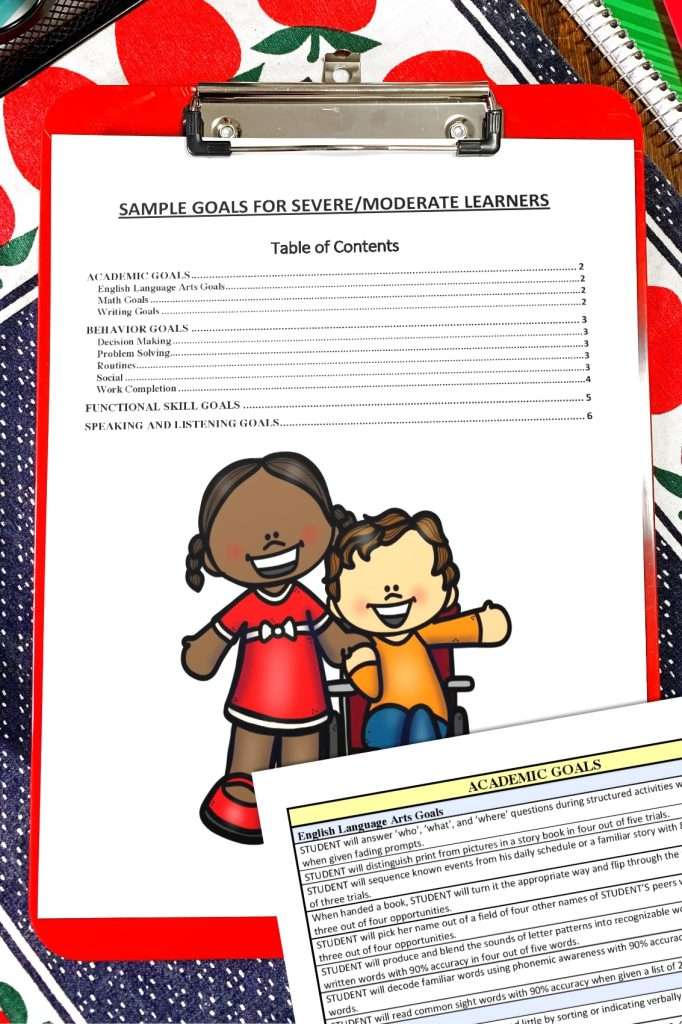
When setting clear and measurable IEP goals, utilizing a smart goal bank can be an invaluable resource.
A smart goal bank consists of predefined, specific, measurable, achievable, relevant, and time-bound goals.
Educators can adapt generic goals to suit individual student needs.
By utilizing a smart goal bank, teachers can ensure that the goals set for each student are realistic, attainable, and tailored to their unique strengths and challenges.
This approach not only helps in keeping the IEP goals focused and achievable but also makes it easier to track progress and make necessary adjustments as needed throughout the school year.
Additionally, smart goal banks can provide a starting point for teachers who may be unsure of how to create appropriate and effective goals for their students.
This method saves time and ensures consistency in goal-setting across different students and classrooms.
Not sure where to start?
Grab your state’s academic standards and turn them into measurable goals.

Create Accommodations and Modifications
An important part of the IEP is the accommodations and modification section.
This area is crucial for students to utilize during assessments and classwork.
It’s meant to level the playing field and make academics more accessible.
Accommodations are changes in how a student accesses information and demonstrates learning.
Alternatively, modifications involve adjusting the content, level, or performance criteria of the curriculum.
To create effective accommodations and modifications, start by consulting the student’s current IEP or most recent evaluation.
This will allow you to understand their specific needs and learning objectives.
Remember that some of these allowances will help students be successful in a way they haven’t before.
Students who are now permitted to have the text read aloud or use talk to text may now start showing their true growth abilities.
This section is often the key to assisting students to a high school diploma.
Also remember that accommodations are applicable in college.
By tailoring accommodations and modifications to meet the unique needs of each student, educators can create an inclusive learning environment where all students can thrive and succeed.

Establish Appropriate Interventions
To establish any appropriate interventions, it is crucial to conduct a thorough assessment of the student’s current academic performance, strengths, and areas of need.
This may involve reviewing past assessments, observing the student in various learning environments, and collecting data on their progress.
By identifying specific areas where the student is struggling, educators can pinpoint the most effective interventions to address those challenges.
Interventions that are often discussed include
- behavior
- reading comprehension
- fluency
- social emotional learning
- counseling
- life skills support
Collaborating with the student, parents, and other relevant professionals can provide valuable input on the interventions.
Discuss what has worked well in the past and those that may need adjustment to better support the student’s learning.
List intervention support in IEPs under services.
A goal should be written for each service with a position, not a person’s name, attached.
Also, remember that if an intervention is only set for 4 months, this is easily noted by adding those times to the service date.
Just because an IEP is a full calendar year, it doesn’t mean that every service is.

Progress Monitoring
One effective way to ensure that interventions are successful is to determine how progress will be monitored.
This involves determining what progress monitoring will be used when you established those beautiful goals you wrote.
By creating specific benchmarks for progress, educators can track the student’s development and adjust interventions.
Regular assessments and data collection can provide valuable insights into the effectiveness of interventions and help educators make informed decisions about the student’s academic support.
Additionally, ongoing communication with the student, parents, and other professionals involved in the student’s education can offer different perspectives on the student’s progress and inform the monitoring process.
I recommend collecting and recording data at least once a quarter.
Then, save all data and documentation as evidence of progress or lack of progress.
Many things can be a progress monitoring portfolio piece including
- in class work
- classroom assessments
- checklists
- observations
- data collection sheets
- office referrals
- grade books
- behavior charts
- student observations
Progress monitoring is so important to make sure students are making growth.
Also, remember that saving your progress monitoring artifacts is a SPED teacher’s insurance policy.
If you ever do to due progress, the hearing officer will ask for all of your IEP support pieces.
One they especially want to see?
Yup, progress monitoring.

Write an IEP with Positive Support
It is essential to provide positive reinforcement and support to help motivate and engage students in their learning.
When students are met with encouragement and praise for their efforts and achievements, they are more likely to feel confident and resilient in the face of challenges.
This can help build a positive learning environment where students have supported.
If you write an IEP that has behavior goals, a behavior plan had to be write.
P.S. You also need an FBA first. Get help here.
Then, make sure you list what incentives, rewards, and tools the behavior plan needs.
Offering support in the form of personalized guidance, visuals, or daily charts can be important support tools to write an IEP.
To figure this out, talk with your student, their caregivers, and teachers.
Flat out ask the student what they want to work for.
When you get unusual requests, get the support of your administration.
For instance, many students want to work for YouTube or a movie.
While this might not feel unusual, it is in a classroom setting.
You will want your administrator to be aware of this reward so when she walks into your room for a teacher observation, she won’t think you let students on the internet whenever they like.
Instead you are a structured teacher enforcing a reward system!

Write an IEP with Supporting Documents
Ensuring that all supporting documents are within the student’s file is crucial for maintaining a comprehensive record of their progress and needs.
First this practice helps teachers with organization.
But also it enables them to have easy access to valuable information when planning and implementing individualized education plans.
Most online IEP data systems let you see each year’s information.
By having all relevant documents teachers can make informed decisions and provide appropriate support to students.
Supporting data to include is
- assessments
- progress reports
- behavior plans
- charts or checklists for behaviors
- relevant medical documents
- letters of consent or dissent
Additionally, having a complete student file can facilitate effective communication.
I love to read over past documents, especially the most recent evaluation, for incoming students.
Having all documents in one location helps teachers help students as quickly as possible.
Write an IEP is one of the most vital tools to support students with diverse learning needs.
By incorporating my tips and tricks, you can create comprehensive and effective IEPs that cater to the unique requirements of each student.
Remember, collaboration with parents, colleagues, and specialists is key in developing successful IEPs.
Also, flexibility and creativity are essential in addressing the individual strengths and challenges of our students.
By focusing on the student’s holistic development and fostering a supportive educational environment, we can truly make a difference in their learning journey.
Let’s continue to empower our students and ensure that every time you write an IEP it leads to a pathway of success and growth.


