


Writing Goals for IEP: A Guide for Educators
Writing goals for IEP is one of the most important parts of planning for a student’s educational path.
Individualized Education Programs (IEPs) are critical tools that help tailor education to the unique needs of students with disabilities.
The success of an IEP lies in setting clear, measurable goals that reflect the student’s current abilities and outline achievable growth targets.
Writing goals for IEPs requires attention to both the student’s specific needs and how their progress will be monitored over time.
The process of writing meaningful IEP goals in key areas such as reading, writing, math, functional skills, and behavior involves a system.
Whether you’re a special education teacher or parent, understanding how to craft these goals can make a significant difference in the student’s educational journey.
Reading Goals for IEP
Reading goals in an IEP are often foundational, as reading is a skill that impacts all areas of learning.
When writing goals for IEP reading weaknesses, it’s important to align them with the student’s present level of performance and show measurable progress.
Reading goals might address a range of skills, from phonemic awareness to comprehension and fluency.
Example: For a student struggling with reading comprehension, you might write:
“By the end of the semester, STUDENT will answers 4 out of 5 comprehension questions correctly after reading a grade-level passage with 80% accuracy in 3 trials.
To show growth, break the goal down into smaller benchmarks.
For example, the first benchmark might be answering questions about key details, while later benchmarks could address higher-level thinking, such as making inferences or summarizing.
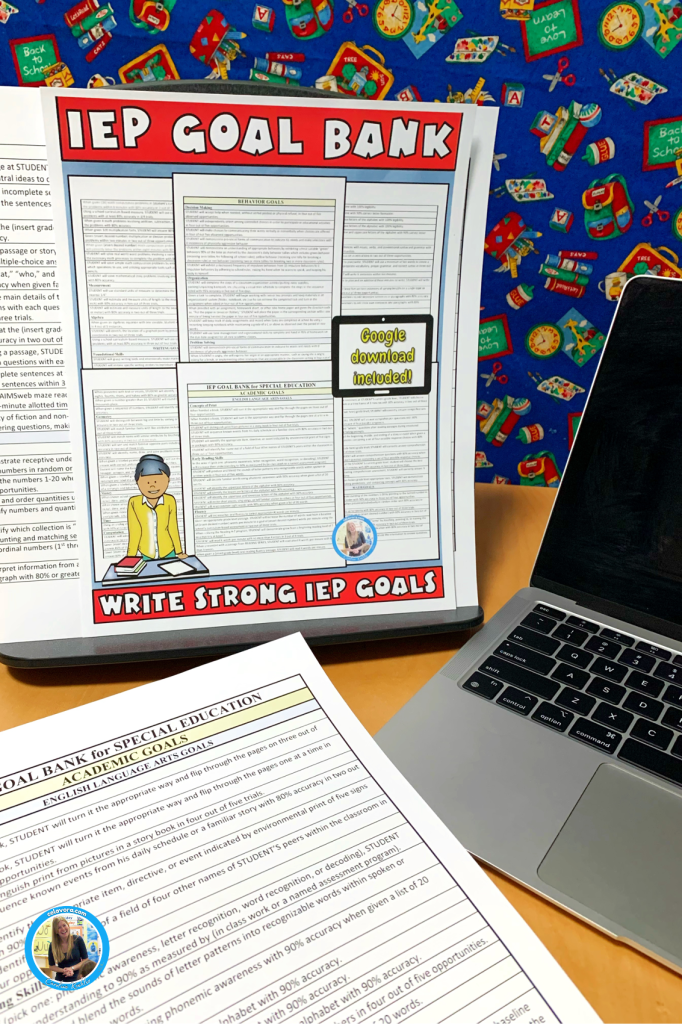
Utilizing a resource like the IEP goal bank can provide goal templates and ideas to ensure that reading goals are appropriate and achievable.
Writing Goals for IEP
Writing goals are often a central focus in IEPs, especially since written expression is a critical skill across subjects.
When creating writing goals for IEP, remember that these goals should be specific, measurable, achievable, relevant, and time-bound (SMART).
Goals may address areas such as sentence structure, grammar, organizing thoughts, or developing coherent essays.
Example: For a student with challenges in written expression, you might write:
“STUDENT will independently write a 5-sentence paragraph that includes a topic sentence, three supporting details, and a concluding sentence with 85% accuracy in structure and grammar, as measured by monthly writing samples from in class work.”
To track growth, include short-term objectives, like the ability to form complete sentences or use appropriate punctuation.
As the student progresses, you can increase the complexity of the writing tasks, such as moving from paragraph writing to short essays.
Use an IEP goal bank to easily find sample goals for different aspects of writing, making it easier to individualize goals based on the student’s needs.

Math Goals for IEP
Math goals in an IEP often focus on building foundational skills that support higher-level concepts.
These can range from basic number sense and operations to more complex problem-solving and reasoning tasks.
When writing math goals, it’s essential to ensure that they’re tailored to the student’s current level while providing a clear path for growth.
Example: For a student working on multiplication, you might write:
STUDENT will solve single-digit multiplication problems with 90% accuracy in 4 out of 5 trials, as measured by weekly math assessments.”
To show growth, you can include benchmarks that start with manipulatives or visual aids, then progress to solving problems independently.
Goals might also cover applying math skills to real-world scenarios, such as using multiplication in word problems or when measuring objects.
Use an IEP goal bank that offers a range of math goals, from basic arithmetic to more complex tasks.
This tool helps teachers set realistic but challenging objectives for their students.
Functional Goals for IEP
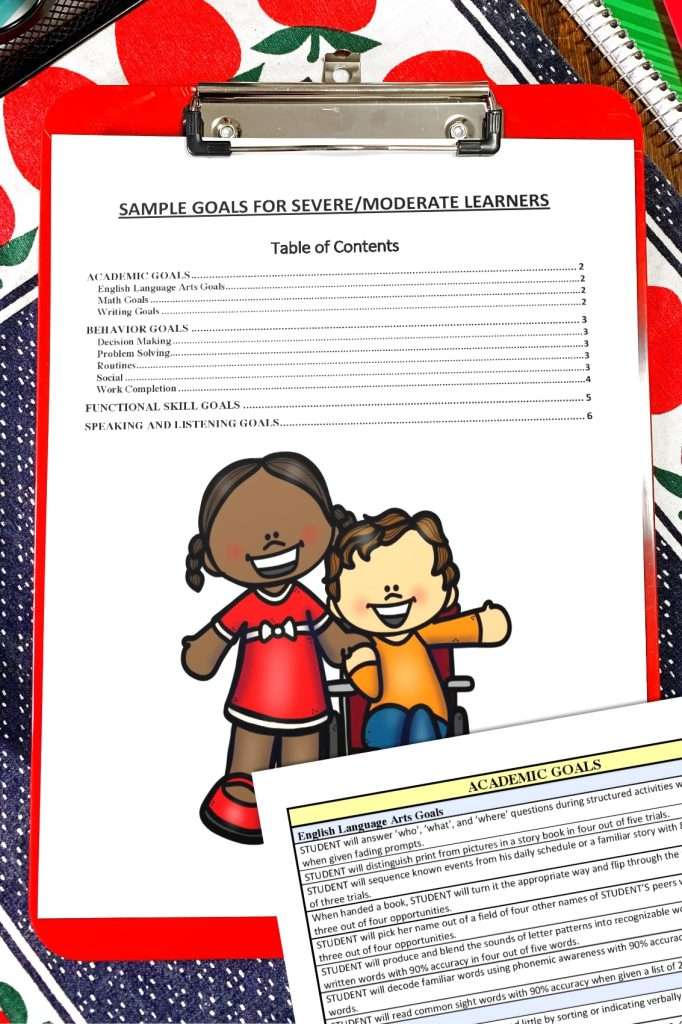
Functional goals address life skills that students need to navigate daily living, social situations, and independent functioning.
These goals are critical for students with significant disabilities or those who need more support in practical, day-to-day tasks.
Example: For a student learning life skills, you might write:
“STUDENT will independently prepare a simple snack by following a 3-step visual recipe with 90% accuracy, as measured by teacher observation and checklists in 5 trials.”
Functional goals can cover a wide range of areas, including personal care, time management, and social interaction.
Showing growth might involve starting with assistance and gradually fading support as the student becomes more independent.
To write functional goals, make sure they are meaningful and aligned with the student’s needs.
Discussing functional skills and goals with the student’s family is key during the case conference committee.

Behavior Goals for IEP
Behavior goals are crucial for students who struggle with self-regulation, social interactions, or following classroom rules.
These goals should focus on teaching positive behaviors and reducing problematic ones.
Effective behavior goals are measurable and specify the expected behavior, the conditions under which it should occur, and how progress will be tracked.
Example: For a student working on self-regulation, you might write:
STUDENT will demonstrate the ability to use a calming strategy, such as deep breathing or asking for a break, in 4 out of 5 opportunities when feeling frustrated, as documented by teacher and support staff observations.”
To show growth, you could include a frequency goal.
An example of this is to include reducing the number of behavioral outbursts from five to two per week.
focus on the student’s ability to use a behavior strategy with less prompting.
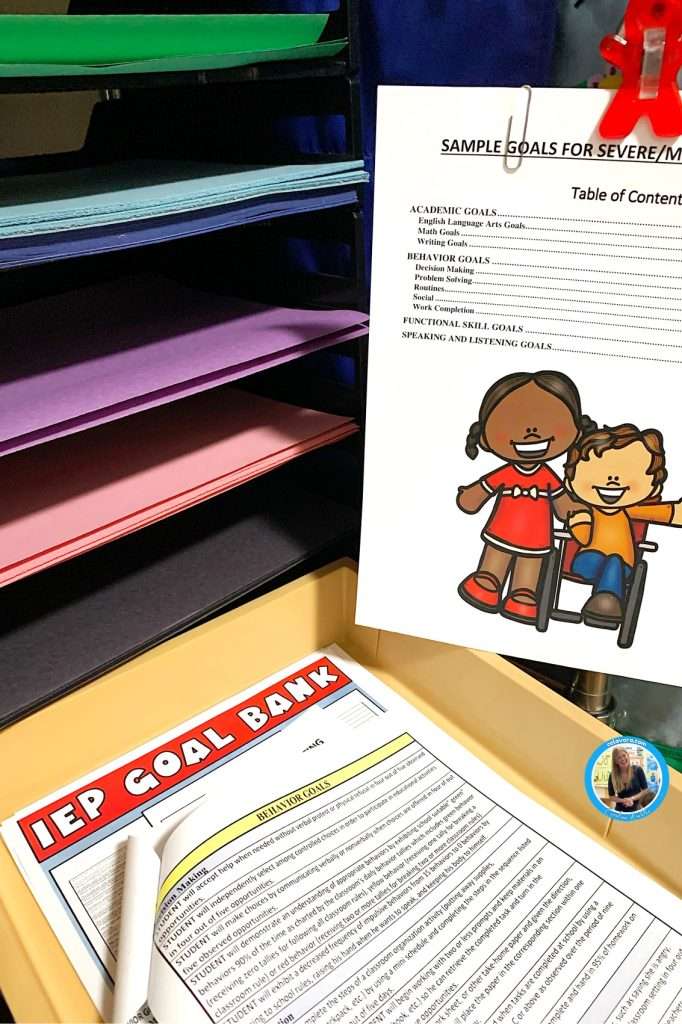
Use behavior goals that can be easily adapted to various needs.
This makes it simpler for you to find appropriate targets for students and document their progress.
Simplifying IEPs
Writing effective IEP goals requires a balance of specificity, measurability, and practicality.
Whether you’re setting reading, writing, math, functional, or behavior goals, it’s essential to focus on individual student needs while providing a clear plan for growth.
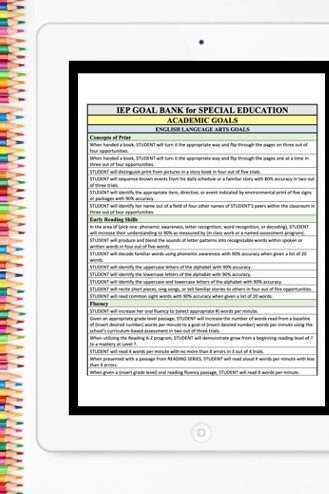
Using resources like the IEP goal bank can help streamline this process, ensuring that goals are both achievable and aligned with educational standards.
By writing thoughtful and personalized goals, educators can create a roadmap that supports student success and fosters long-term development across all areas of learning.
You’re ready! Go grab your computer and go start writing goals for IEP students!


