


Behavior Management Systems for the Well-Run Classroom
A well-run classroom is the key for learning but requires positive behavior management systems put in place.
There are many options for behavior management support.
Sometimes a whole class system might be necessary and other times a strategy for a specific student is super important.
Read through the ideas below and think what would work for you and your students.
This changes as we change so having a treasure box of behavior management systems is super helpful.

First Then Boards
First-Then boards are a great and easy-to-use tool for students who need extra support with focusing and following school rules.
These boards typically involve setting a goal (like completing work) and choosing a reward that follows it.
For instance, the teacher might select a “Do your work” goal picture and place it under “First” on the board.
Then, the student or teacher would choose a reward and place it under “Then.”
When the student completes the goal, they receive the reward right away.
I use First-Then boards for students who require consistent reinforcement, particularly those facing significant behavior challenges or with cognitive disabilities.
These boards can also be effective for students who can sustain an activity or task for an extended period.
To use either type of board, select the goal for the student and place it in the first box.
Choice boards are a crucial component of the First-Then boards.
Students choose between 4 to 8 incentives that they are interested in working for. From these options, they select one to focus on for a reward.
Place the picture card on the First-Then or First-Next-Then board.
At the start of each new goal, the student can pick a different reward.
Provide a range of choices the student can pick from and place their selection in the box under the “Then” box.
Once a goal under the “First” has been achieved, the student is immediately moved to the “Next” box or given the reward under “Then,” depending on the board being used.
Continue selecting goals and incentives throughout the day.

I’m working for boards
A similar tool to the First Then boards is the “I am working for” board.
These behavior supports help for students who need extra motivation, including those with behavior plans.
Also, I often include these in Individualized Education Plans (IEPs) for students with behavior goals.
These printable boards come with 44 pre-made incentive pictures and blank spaces for you to add your own.
I recommend printing them in color, laminating them, and attaching Velcro to the cards, dots, and reward pictures.
There are three versions of the “I am working for” boards, each with 3, 4, or 5 empty circles.
Students start with the 3-circle board for faster reinforcement, then move to the 4-circle board, and finally to the 5-circle board.
Transfer the yellow dots one at a time to the empty circles when you observe the positive behavior.
When the student earns all the dots, they can trade them in with the teacher for the reward.
I use these boards frequently for students with autism in general education classrooms.
The visual aids and the dots help them see the goal and work towards it gradually.
Also, the choice boards are an essential part of the “I am working for” boards.
The teacher identifies a target behavior on the choice board labeled “My goal,” with 41 pre-made goals to choose from.
It’s important to have the behavior and rules visibly posted for reference.
Then, the student then selects between 4-8 incentives they are interested in working for, choosing one to focus on for a reward.
They can pick a different reward at the beginning of each restart of the card.

Points Behavior Management Systems
The goal of the points page is to work on the behaviors teachers desire to see in students.
These sheets help students develop teacher-selected goals and earn positive points to achieve student-selected rewards.
Identify four goals to target for the student and transfer these goals onto the points page you have selected.
Then the student selects incentives to work for.
The student will receive points for each row, which are then added together to give a total at the bottom of the page.
Students then use these points as minutes for a preferred activity at the end of the day.
Most students desire activities like computer time, iPad time, or movie time.
However, if a student needs more frequent rewards, you can tally and redeem points once before lunch and once at the end of the day.
Word all goals positively, telling the student what to do rather than what not to do.
For example, “hands to self” is better than “no hitting.”
Throughout the day, the teacher looks for opportunities to give the student positive points.
If the student is attentive, the teacher can say, “Give yourself a point,” and the student records the point.
Then, place points pages on a clipboard and take them with the student throughout the school building.
All teachers, assistants, and administration can provide the student with points.
Teachers should strive to give as many points as possible to a student, as research has shown that this increases the targeted behavior.
When a student breaks a rule, a reminder of the goals and the points that earns their desired activity is given.
If the rule is broken again, the teacher gives the student a negative, which decreases their minutes by 4 points.
At the teacher’s chosen time, points are redeemed for the student’s desired activity.

Classroom Control Cards
Stopping a lesson to correct a student disrupts from valuable instruction time and takes away from the flow of your lesson.
Address behavior concerns the quick and easy way with classroom control cards.
When I am teaching and notice a student off-task (talking, playing with an item, daydreaming, etc.), I take out the appropriate card from an organized pocket chart, walk over to the student, give them the card, and return to my spot.
I continue talking and teaching as I do this.
When I finish with a lesson, I can conference with the student and collect the cards.
I file the cards back into my pocket chart, so they are available for use later.
Cards I use as follows.
Talk to Teacher Card
Use this card to tell the teacher one thing. When you are out of cards, the teacher will not listen to your stories.
These cards are only for students who need help monitoring their off-topic language including storytelling and tattle telling.
Think Break/Think Break Writing Cards
What can you do to get your behavior under control right now?
Please write the problem and your solution for improving your behavior down on the Thinking Break
Writing card. Return the cards to the teacher when you are done.
Quiet Cards
Your voice level is too loud. Quiet your voice and be respectful to your neighbors.
Give these cards to students who are loud during whole group activities, partner time, group work, or individual work time.
Wait Cards
I’m not available right now. Ask a friend to help you. I will come seeyou in a moment.
Keep these with you when you are doing one-on-one instruction or working with a group.
Hand a card to a student who attempts to interrupt you.
Raise Your Hand Cards
Blurting out interrupts others. Raise your hand and wait your turn. Being respectful to others shows kindness.
Use these cards when you are teaching in whole or small group and you have a student talking out of turn.
Do not verbally acknowledge the student but simply place the Raise Your Hand card on their work area or in their hand.
Different Choice Cards
Please stop what you are doing. Make a different choice. Do your work and stay on task.
Use this card when students are off task during classroom assignments.
Have the students return the cards to your designated area after it’s been used.
Try Again Cards
This is a do over. Fix your mistakes to grow. Help is available if you need it.
Give these cards to provide any student with a do-over for either work or behavior.
I often give these when students use disrespectful language.
Be Respectful Cards
Your words and actions have meaning. Please fix your behavior and treat others with kindness and respect.
Every now and then, I get a class who has a challenging time stopping put downs.
I teach respect every year but find these cards more important when I have disrespectful classes.
Give a student the card when they’ve made a disrespectful comment to a staff or student.
Hold the student accountable for fixing their error and having a do-over to reflect respectful language and actions.
Teach and model this in whole group often to see the most gains.
Think Sheets
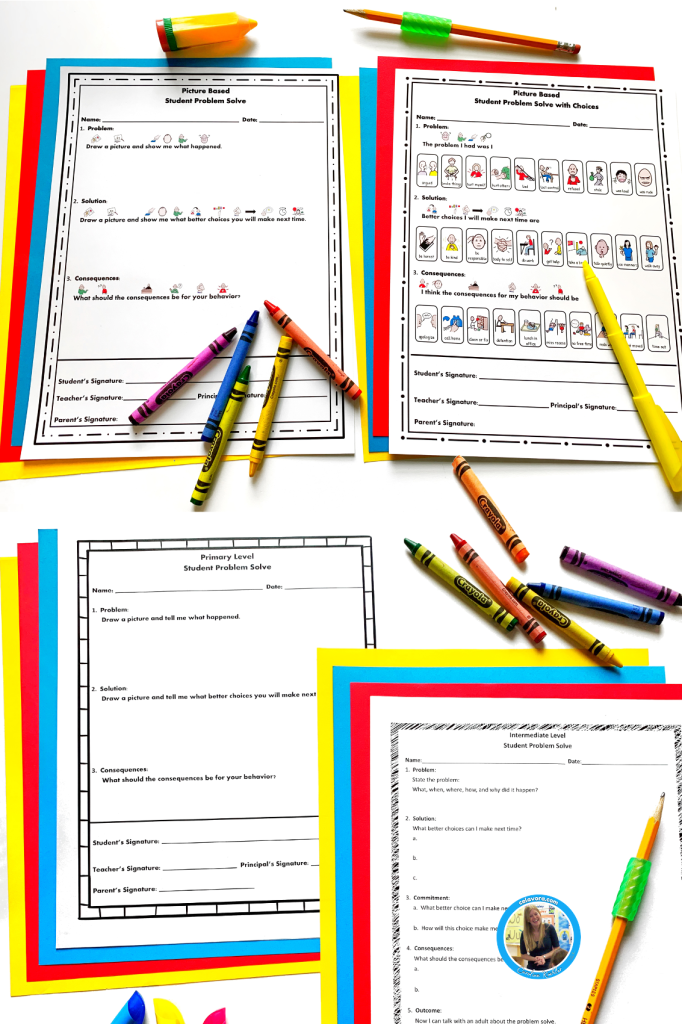
Think Sheets address behavior that requires intensive support, is habitual, or needs documentation.
This set is suitable for all students, including those with special needs, as it is easily understood.
Picture-based with choices think sheet is ideal for very young students, those with special education needs, or students who cannot generate their own responses.
Easily level text-based think sheets for primary students in grades K-2 and intermediate students in grades 3-8.
While filling out the sheet with the student can be valuable, if the student is able to complete it independently and then reflect with an adult, this is the preferred method.
Whenever possible, have the student fill out the sheet so that it is in their handwriting.
Then, explain to the student that a copy of the paper will go home, and another copy goes in their cumulative records file.
Next, before sending the paper home, call or email the parent to inform them and discuss the behavior with their child.
Lastly, ask the parent to sign the sheet and return it to school.
These sheets can be used for behavior documentation and progress monitoring if applicable.

Reward Charts
Reward charts are a fun win-win for everyone.
Use stickers or stamps with a fun motiving reward chart for your students or whole class.
Discuss the chart and make sure the child knows what skill or activity they are working on (potty training, chores, homework, manners, teeth brushing, etc.).
Then, fill the chart in by coloring the shapes, adding a sticker, making a stamp mark, or writing your initials.
Once the chart is full, make sure to give the child his reward right away.
To continue working on the goal, print and start a new sheet.
Changing the chart to a different theme helps keep the child interested and motivated.
Anytime a new goal is created, take time to discuss the chart and incentive with the child.
The included charts have 15-20 progress points on them.
Typically, you give a student one point where they add a sticker, a stamp, or color in one point at a time.
If the student or class does something amazing, feel free to give them more than one point at a time.
For example, if they organized their area and completed all of their homework without prompting, you might want to have them color in 5 points.
Make sure they understand why they are receiving more than 1 point at a time.
However, you choose to use the charts is up to you but make them meaningful and fun for all involved!
Then, place the chart in an easy to access area where both you and the child can easily see the progress that’s being made.

Behavior Charts
Daily behavior charts highlight positive behavior while giving teachers crucial daily data for progress monitoring and future planning.
Classroom behavior charts are excellent for both elementary and secondary students.
It’s perfect for behavior improvement plans, IEPs (Individual Education Plans), and RTI (Response to Intervention).
These behavior charts have proven effective for students with exceptional needs including
- Autism
- Asperger’s
- ADD (Attention Deficit Disorder)
- ADHD (Attention Deficit Hyperactivity Disorder)
- ED (Emotional Disability)
- OHI (Other Health Impairments)
- Mild Cognitive Impairments
- Specific Learning Disabilities
With a variety of sheets, you can select what suits your students best.
This lets you provide different levels of support for individuals with varying cognitive levels and emergent readers.
Also, whenever I start a student on a new behavior chart, I send an email out to all parties.
This makes sure that all adults understand the chart and how to use it to help the student.
Interactive Behavior charts
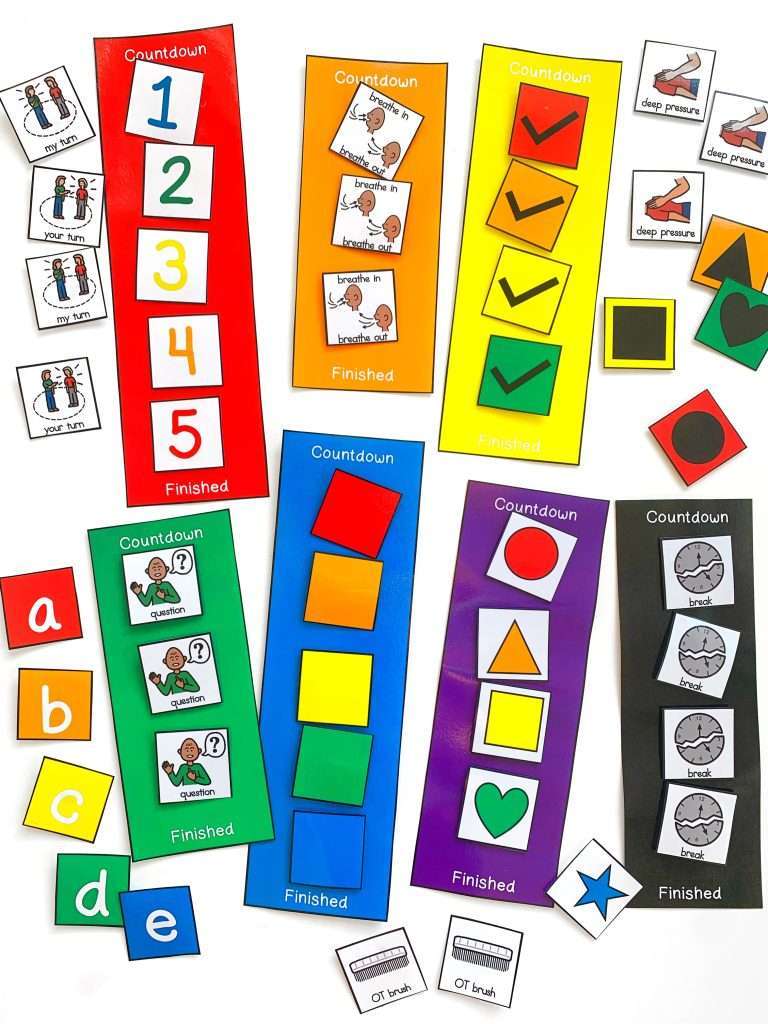
Interactive behavior charts are great because they don’t need printed or copied daily.
The drawback is that teachers don’t have ongoing evidence of success or failure with the tool.
To help with that, I use a data sheet to record how the student responds each day to the behavior management system.
Teach this tool before using it as a behavior tool or monitor.
Demonstrate how the board works.
For young students I like to start with smiley faces countdown boards.
Typically I start with the board full of smiley faces. I tell the student, “We are going to do one thing and pull off a smiley face.
When you’ve earned all the smiley faces from the board, you get your reward/break.”
I practice with really simple activities first such as reading one page in a book (independently or as a participant), putting one piece in a puzzle at a time, practicing standing, sitting, lining up, etc.
Once the board is full, the activity is complete.

Check in Check out Behavior Management Systems
Establish lasting positive habits with the check-in, check-out intervention for elementary, middle school, and high school students.
These versatile lists are suitable for both general education and special education students, designed for use at school and at home.
Simple for students, parents, or teachers to complete and track performance in a range of life skills.
Typical uses for check in check out behavior management systems include
- Am I Finished
- Backpack
- Behavior
- Desk Cleaning
- Emotions
- Homework
- Locker Cleaning
- Materials
- Morning for School
- Morning for Home
- Organization
- Responsibility
- Rules
- Work
Utilize this set for teaching and monitoring student skills and behavior across various school, home, and clinic settings.
I suggest employing the check-in, check-out intervention templates for progress monitoring support.
Additionally, check-in, check-out is an excellent tool for interventions and social-emotional learning (SEL).
These record-keeping forms are beneficial for special education teachers, social workers, general education teachers, counselors, clinicians, and parents.

Communication boards for behavior management systems
Assist your students in expressing their needs effortlessly with printable and digital basic needs communication boards.
These behavior management systems aides students with autism or communication disorders/language delays in communicating more effectively at school.
I use these daily with students who have multiple disabilities and have observed fantastic results!
These communication boards are a simple format with basic, plain pictures to be as effective as possible for individuals with disabilities and young children.
Instead of using sentence strips, these boards are meant to be printed in full pages.
Students can easily point to their choices, making them wonderful resources for nonverbal students and a go-to for students with behavior concerns.
Many students struggle to express their needs when their bodies are dysregulated.
These simple communication boards allow students to point to what they cannot say verbally.
Because of this it helps deescalate situations more quickly and allowing the child to be heard when they are unable to verbalize their needs and thoughts.

Visuals for behavior management systems
Utilize visual scales as behavior management systems to assist children in learning how to regulate their emotions.
Visual scales offer a clear and concise method for communicating expectations, tracking progress, and providing positive reinforcement.
The SEL tools included provide strategies to help children understand and manage their emotions, communicate effectively, build positive relationships, and make responsible decisions.
The SPED visuals offer practical and visual supports to help children stay focused, organized, and engaged in learning.
Whether you’re a parent, teacher, therapist, or caregiver, the Autism Behavior Management Solutions Bundle offers a user-friendly and customizable approach to supporting children with autism and special education needs.
With its clear and engaging visuals, this bundle is an essential tool for promoting positive behavior, social skills, and academic success.

Behavior Management Systems
Lastly, all good behavior management systems focus on positively worded classroom rules.
Classroom rules and procedures posters streamline the organization of a teacher’s back-to-school behavior management plan.
Posters clarify teachers’ expectations and are perfect for establishing a well-run classroom with practical rules and visually appealing displays.
Use visual rules to support all students, including general education students, early readers, nonreaders, and individuals with special needs, including autism.
Display the posters around the school building and in your classroom, referencing them often and pointing out when students follow the rules.
Then, teach the procedures to your students by explaining, modeling, and consistently addressing the rules.
Reinforce procedures after school breaks to ensure students continue following them.
So, now take a look back at all of the behavior management systems.
Ask yourself what works for you and what would work for your students.
Then, try one out and get to work.
If you need a fast place to start, here’s a collection of my favorite behavior management systems.


